REVIEW
Defining Moments and the Formation of Leader Character: The Battlefield, the Boardroom, and Beacons of Hope
Gerard H. Seijts, Ivey Business School, Western University
Kimberley Milani, Ivey Business School, Western University
Andriy Rozhdestvensky, Lviv Business School, Ukrainian Catholic University
Paul Carroll, Pathfinder Leadership Associates
Stephen Virgin, Canada Revenue Agency
ABSTRACT
Crises are defining moments for leaders that test their competencies, character, and commitment to their roles. These events shape individuals as leaders while providing opportunities to influence the future. If leaders aim to foster greater flourishing—encompassing security, prosperity, well-being, and justice—they must rely on their strength of character to envision and achieve it. Crises underscore that character is the foundation of effective leadership. Competencies and commitment—often the focus of leadership literature and executive education—cannot reach their full potential without character. This article examines the leadership of Ukrainian president Volodymyr Zelenskyy during the Ukraine war. It explores how lessons from the battlefield and government can be applied to other sectors and highlights the importance of character in withstanding crisis. Additionally, this article discusses the use of intentional, directed practice as a tool to help leaders develop character, enabling them to navigate crises and emerge as stronger leaders who inspire hope and generate a better future.
Keywords: Defining Moments, Leadership, Character, Deliberate Practice, Reflection
Citation: Journal of Character & Leadership Development 2025, 12: 325 - http://dx.doi.org/10.58315/jcld.v12.325
Copyright: © 2025 The author(s)
This is an Open Access article distributed under the terms of the Creative Commons Attribution License (http://creativecommons.org/licenses/by/4.0/), which permits unrestricted use, distribution, and reproduction in any medium, provided the original work is properly cited.
CONTACT: Gerard H. Seijts gseijts@ivey.ca
Published: 07 April 2025
Crises are defining tests for leaders, challenging their competencies, character, and commitment to their roles. Such crisis moments force individuals to reflect upon aspects of the self and the environment within which they operate. Crises can shape the way individuals embody leadership by inspiring alterations in mindset and conduct. Furthermore, the insights and wisdom gleaned by reflecting upon challenging moments can generate momentum and new actions that contribute in positive ways to a shared global future.
Leaders who are operating during wartime demonstrate the way that a crisis acts as a crucible in which they must draw upon and hone their strength of character or risk certain failure. Character, often overlooked or misunderstood, is essential to successful and effective leadership. Understanding character through an observable and measurable framework and examining how it is developed offer a way for leaders to develop character with intentionality.
The crisis moments of the battlefield provide valuable lessons in leadership and the development of character. But, these lessons not only are relevant to political or military leaders but also can be translated into the public, private, and not-for-profit sectors. Ukrainian president Volodymyr Zelenskyy exemplifies a leader navigating a crisis, namely, an unprovoked war with significant human casualties (Spector, 2023; Zachara-Szymańska, 2023). It is a war with an irrational foe that is aimed at destroying Ukrainian identity, and it has forced a reliance on international support for the country’s very survival. Throughout the war, Zelenskyy has conducted himself in a calm, composed manner and has demonstrated determination and perseverance when confronting difficult situations. He has inspired and mobilized collective action against Russia at an unprecedented breadth, depth, and pace by rallying Ukraine’s citizens and its military, as well as galvanizing most of the international community.
When United States officials offered Zelenskyy the chance to flee advancing Russian troops, his famous response, “I need ammunition, not a ride,” became a defining leadership moment (Spector, 2023). The response exemplified his courage and commitment, resonating with both Ukrainians and the international community. Zelenskyy sent an unmistakable message to the world: he refused to bend to fear or to prioritize his own safety. Sidestepping tough challenges and capitulating to fear in difficult times is commonly seen. But while fear creates feelings of isolation, courage and positive emotions—conveyed through social media, video recordings, and speeches—are contagious (Barsade et al., 2018; Seppälä & Cameron, 2022). Zelenskyy’s rhetorical skills are considered one of his biggest strengths. Zelenskyy has neither minced his words nor peppered his candor with insult. Rather, his earnest speeches have been transparent, composed, and heartfelt. His carefully chosen words have sought to unify rather than divide; he achieves this in part by invoking historical events and experiences that resonate with his audiences (e.g., referring to Shakespeare and Churchill in his address to the United Kingdom House of Commons), reminding his audiences they are helping to defend common values such as democracy, respect for human rights, and fundamental freedoms.
Zelenskyy’s strong leadership and depth of character was not apparent until it was critically called upon. Before becoming president of Ukraine, Zelenskyy earned a degree in law from the Kyiv National Economic University, following which he created the production company Kvartal 95 and produced films, cartoons, and television shows. He has been a successful actor and political activist. There was very little in Zelenskyy’s past to suggest that he would become an admired and heroic wartime president and yet, arguably, he has (Urban & McLeod, 2022). This example suggests that unlikely people can rise to the challenges of crisis leadership when they call upon and draw forth their strength of character.
When fate taps a person on the shoulder, it provides a stimulus for personal growth: the opportunity to respond in a way that is unique unto themselves while also inspiring and galvanizing others. It may be argued that whatever happens in Ukraine, Zelenskyy has had a far-reaching impact on the rest of the world. His example of strong, effective leadership provides a concrete example to other leaders as the world collectively faces numerous other converging crises (e.g., health and climate emergencies, social and economic inequality, declining trust in public institutions, or technological disruption). Leadership that is informed by strength of character has the potential to address present and emergent crises, and to effect change. Imagine, for example, how different the world could be if leaders—in government, business, sports, education, and other areas—would step up the way Zelenskyy has?
Purpose
The purpose of this article is threefold. First, this article notes that the battlefield supplies a true and exacting laboratory of leadership and leadership development. Military officials have articulated that little, if anything, prepares leaders for the kind of existentially consequential decisions and trade-offs that they must make on the battlefield, in the midst of chaos, armed conflict, rape, genocidal violence, humanitarian crises, and other atrocities. Leaders, therefore, need to be capable of making quick, well-reasoned, and high-impact decisions in volatile, complex, and ambiguous situations (Antonacopoulou & Bento, 2018; Wu et al., 2021).
Second, this article highlights the importance of character to strong, effective leadership and decision-making. Competencies and commitment, often the focus of leadership literature and executive education, cannot reach their full potential without character. This is not a revolutionary or even modern idea; thinkers as far back as Aristotle espoused the value of character development. This article advances a character-based approach to developing leaders. Research in military service, business, education, and consulting shows that a renewed focus on character development elicits positive growth and a dedication to becoming a better leader (Crossan et al., 2024; Sosik et al., 2019).
Third, the article considers how lessons from the battlefield and government translate into other sectors; in particular, it explores the formation of leader character during crisis and applies the lessons found there to employees, leaders, and board members in the private, public, and not-for-profit sectors. Anecdotal evidence suggests that many successful senior executives in government and business have been able to combine hard-won lessons of military leadership principles with real-world business applications.
Raising important questions about leadership theory, leadership research, and leadership development, this article facilitates a deeper understanding of the importance of character in leadership, as well as the ability to recognize its tangible, observable behaviors in leaders, both in the personal and the professional spheres. This article puts forth three reflective practices that leaders can undertake to develop their character as it relates to leadership: (1) personally consider the importance of character and how to exercise strength of character in all areas of life; (2) think deeply about how to end the character deficit crisis currently being witnessed; and (3) reflect on how intentional and deliberate practice facilitated by defining moments can cultivate leaders with strength of character.
Leader Character
Extensive research has reinforced that when it comes to strong, effective leadership, competencies count, commitment to the role of leadership is critical, and character matters (Crossan et al., 2024; Thompson et al., 2008). Competencies reflect what a leader can do (Campion et al., 2011). Examples of competencies include strategic thinking, communication skills, motivating people, and negotiating complex agreements. And while individuals may possess such innate competencies, research has also shown that these (and other) competencies can be developed through interventions such as training, role-play scenarios, assignments, and coaching (Avolio et al., 2009, 2010).
Commitment describes the degree of effort and persistence that a leader applies to create the forward momentum required to make things happen; it is based on the individual’s level of aspiration, their degree of engagement with personally or organizationally relevant goals, and the sacrifices they are willing to make to reach a goal (Baker, 2011; Gandz et al., 2010). Consider the example of Zelenskyy. By all accounts, he has not taken a day off from the war—and he knows that he risks his life every day. Former Minister of National Defense Oleksii Reznikov said, “He’s in stress mode 24 hours a day, 7 days a week–it’s a never-ending marathon” (Balmforth et al., 2024, para. 12).
Character can be described as a habit of being anchored in a set of virtues, values, and personality traits (Peterson & Seligman, 2004; Pike et al., 2021). Virtues are situationally appropriate or worthy behaviors, such as humanity and courage, which are widely considered to be emblematic of effective leadership because they contribute to the well-being of individuals and, ultimately, societies (Newstead & Riggio, 2023; Sosik, 2015). For example, without the virtue of courage as modeled by Zelenskyy, Ukrainians would likely not have felt as strongly about their ability to stand up to Russian invaders and fight back. Zelenskyy made numerous high-risk trips to frontline positions in cities such as Bakhmut, Bucha, Irpin, and Kherson to personally thank soldiers who have been involved in fighting, to present state awards and honorary titles to those individuals who distinguished themselves in battle, and to offer support to residents who witnessed unimaginable atrocities. He lives by the maxim that leaders move toward the sound of gunfire because that is where the action and the danger lays. Doing so can be counterintuitive for a leader but to do otherwise is to shy away from an opportunity to influence and build relational togetherness.
Some virtuous behaviors reflect the activation of personality traits, such as resilience and self-control. For example, studies have shown that building resilience helps mitigate emotional and psychological injury and enables recovery after war-related trauma (Fino et al., 2020; Litz, 2014). Character and personality traits such as the five-factor model of personality (Barrick & Mount, 1991; McCrae & Costa, 1987) are not the same; there are fundamental differences between these two constructs. One crucial difference is that character is anchored in virtuous behaviors and can be strengthened through deliberate practice, and sometimes through a specific, intense experience. Conversely, personality traits tend to be relatively stable and, importantly, mostly agnostic to virtue (Cawley et al., 2000; Peterson & Seligman, 2004).
Furthermore, some virtues are expressed as values, such as justice. For example, studies reveal that when leaders demonstrate justice, it helps motivate people within their organization to direct their energies and skills toward addressing common goals and challenges that the organization is facing (Greenberg & Colquitt, 2013; Whitman et al., 2012).
Leaders in the public, private, and not-for-profit sectors have demonstrated that strength of character elevates leadership and thus increases the likelihood of success in addressing the evolving demands and challenges that await leaders. For example, the temperance Zelenskyy showed in his communication with Ukrainians and the world is very effective. In a February 26, 2022 video posted online, Zelenskyy revealed that he was still in Kyiv and said, “I am here. We are not putting down arms. We will be defending our country, because our weapon is truth, and our truth is that this is our land, our country, our children, and we will defend all of this. That is it. That’s all I wanted to tell you. Glory to Ukraine” (CNN, 2022, paras. 5–6). The leadership that emerged under Zelenskyy during the early days of the war—calm yet passionately resolved—was critically important: the positive relational energy that Zelenskyy created led people to believe they mattered, and that they were needed to win the war and help build a better, stronger Ukraine for future generations.
Many people, including scholars, philosophers, and generals, have written extensively about war and the role of strategy, tactics, leadership, and strength of character. For example, Sun Tzu was a legendary military strategist in ancient China. He is traditionally credited as the author of The Art of War—a book that is generally accepted as a masterpiece on strategy and tactics, and that has been frequently referred to by generals and scholars. Sun Tzu (2021) says five dangers await the general: (1) if they fight recklessly and imprudently, they will surely perish; (2) if they fear death, they will be imprisoned; (3) when they are angry and on fire, it is easy to provoke them; (4) when they are arrogant, they are easy to offend; and (5) a general who loves people too much is easily alarmed and disturbed. Each of these five behaviors is a character-related failing and, correspondingly, harmful to soldiers and their nations.
A Model of Character
Many people erroneously believe character is a subjective construct that resides in the eye of the beholder, as well as being something innate. However, contemporary models or frameworks of character focus on specific behaviors that embody character-based leadership (Brooks et al., 2019; Kiersch & Gullekson, 2021; Lamb et al., 2021; Ruch et al., 2014; Wang & Hackett, 2016, 2020). Crossan and colleagues developed and validated the leader character framework shown in Figure 1 (Crossan et al., 2017, 2024). The framework is based on both qualitative and quantitative research involving over 5,000 leaders from the public, private, and not-for-profit sectors in North America, Asia, Europe, and South America. The language embedded in the framework is based on prior empirical research as well as input and data gathered from leaders within various sectors and industries (and meeting the 10 review criteria to content, measurement, and development; see Peterson & Seligman, 2004).
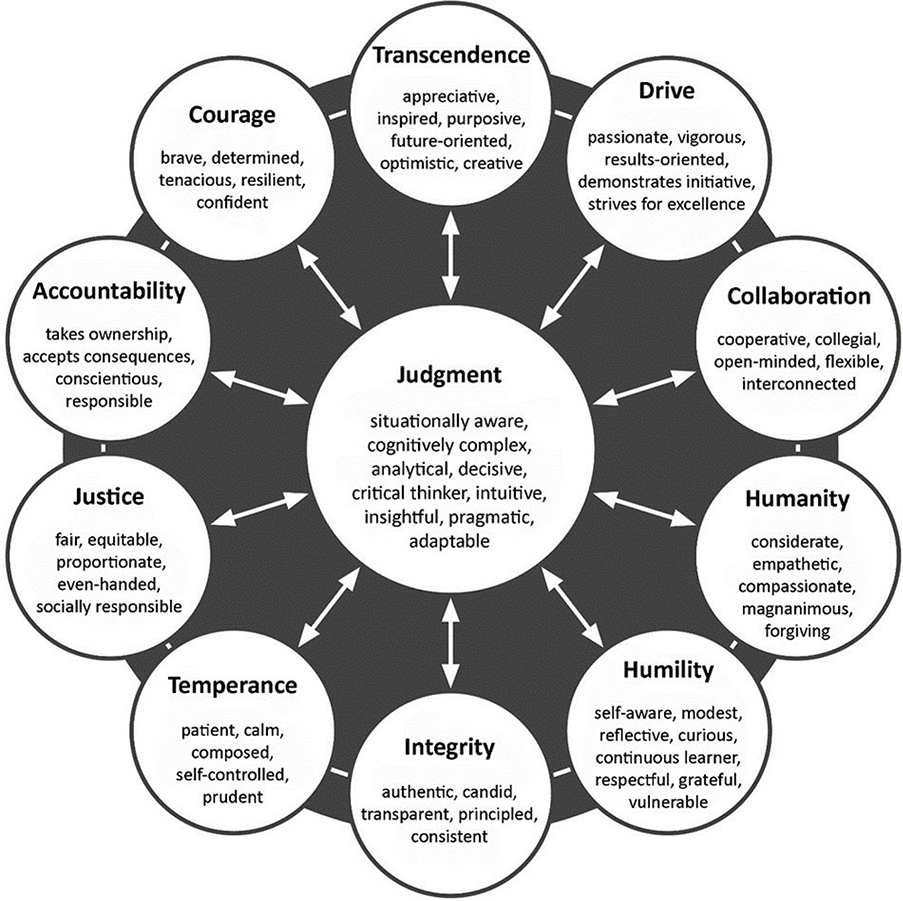
Figure 1
Framework of Leader Character, Adapted from Crossan et al. (2017).
The framework highlights 11 distinct dimensions of character considered relevant to strong, effective leadership and 62 behaviors (or character elements) that are illustrative of the dimensions. The behavioral description of each character dimension is shown in Table 1. Each of the character elements has an impact on the strength of the corresponding character dimension; hence, the easier it is for a person to activate a particular behavior, the stronger the associated dimension will be (Wang & Hackett, 2020; Wright, 2015). And while virtuous or positive behaviors—inherent in the definition of character—are all favorable, there is considerable anecdotal and empirical evidence of variance in the extent to which leaders evaluate and actually display such behaviors (Monzani et al., 2021; Seijts et al., 2019).
In leadership development, temperance tends to be the weakest dimension of character in leaders operating in the public, private, and not-for-profit sectors. Consider again the example of Zelenskyy. How does he, or any leader in a wartime situation, maintain such a calm demeanor—given the horrific reports—the countless missile and mortar attacks, the hundreds of billions of dollars of damage to infrastructure, the witnessing of death and injury, the use of rape as a weapon of war, the attacks on hospitals and healthcare facilities, and the stories about family separations and children being kidnapped—and not have his judgment be compromised by anger or rage? The dimensions of character offer several possibilities. Perhaps he maintains his composure because he is committed to being accountable to his people, and he knows they need a leader whose role is to guide them through such atrocities. Perhaps his transcendence allows him to remain future-oriented and optimistic that Ukraine will prevail. Perhaps his calm is inspired by a deep sense of interconnectedness with the very people he is leading, who have yet to give up on the dream of victory. Regardless of which dimensions of character he is drawing upon, they equilibrize the anger to ensure that his judgment is balanced and uncompromised.
Understanding the networked nature of character is critical to comprehending how character functions—for better or for worse. The dimensions and their concomitant elements shown in Figure 1 independently and interactively influence individual behavior, hence team and organizational outcomes. For example, when engaged in coaching or developing others, being candid when providing feedback can take courage; however, it is only when courage is coupled with empathy or compassion that feedback can be truly heard and accepted, and meaningful and lasting behavioral change can occur. Conversely, failing to activate the right dimensional balance can create a behavioral gap that, due to the lack of a necessary element, generates a negative outcome including but not limited to resentment, lack of trust, and anger (Seijts & Milani, 2024). Such imbalance may explain deficiencies in judgment by leaders who demonstrate behaviors associated with, for example, drive, yet do so in a way that reveals little humanity and justice.
To illustrate, a 2021 survey among Ukrainian military leaders revealed that they rated the dimension of judgment as the most important of the 11 dimensions of leader character—more important even than courage (Monzani & Rozhdestvenskyy, 2021). The surveyed leaders may have recognized that an excess of courage—perhaps recklessness—may compromise judgment.
Research has provided compelling evidence that character is essential to performance and sustains excellence at the individual, team, and organizational levels (Crossan et al., 2024; Neubert et al., 2022; Newstead & Riggio, 2023; Sosik et al., 2012, 2019). The crucial and far-reaching consequences of character beyond military leadership are summed up by a Canadian executive and director in the private and public sectors: “I believe leader character is the bedrock of an organization. I believe over the long-term character becomes the destiny of the organization. Character helps to build and sustain a business over long periods of time” (as cited in Seijts et al., 2019, p. 245).
Judgment
In a complex and complicated world, with increasing economic, financial, social, geopolitical, natural, and technological volatility, there will likely be frequent shocks to the environment in which organizations operate. Therefore, leaders often deal with what scholars Rittel and Webber (1974) coined wicked problems—problems that require both deep insight into the heart of challenging issues and critical thinking about them. Wicked problems are situations that demand sound judgment, the central component of character.
Judgment is central because it facilitates the direction of all other dimensions of character toward a balanced expression; it prevents an individual from falling into behavioral extremes (Eikeland, 2006; Schwartz & Sharpe, 2010). Leadership is always context-dependent, and as such, wise leaders—those who exercise good judgment—understand, for instance, when it is appropriate to encourage collaboration and when it is appropriate to be more directive; when to demonstrate humility, and when to be assertive.
A 2008 Canadian military example illustrates an ethical dilemma, including a set of conflicting principles, that required sound judgment. Captain Robert Semrau of the Canadian Armed Forces was convicted of a war crime for killing an injured Taliban insurgent after a heavy firefight in Afghanistan. The Taliban fighter had been shot by a U.S. Apache helicopter. A veteran Afghan army officer told a court-martial that the fighter was so badly injured he was “98 percent dead…there was no possibility for him to stay alive that day. He could die in 5 minutes, 10 minutes, or a half hour.…His legs were cut off, his belly torn off. The intestines were coming out. From the middle down, everything was gone. He was hardly breathing. His body was not moving” (Graveland, 2010, paras. 3–8).
Neither Afghan government forces nor Canadian officials offered medical care to the injured fighter because it was determined that no medical intervention would prevent his death. Compounding the decision-making process was the fact that calling in a medical evacuation helicopter would place the crew and aircraft in danger since the area was still very much a battlefield. Semrau told a colleague that “he couldn’t live with himself if he left an injured human being—and that no one should suffer like that” (Chase, 2010, para. 12). He then performed a mercy killing by aiming his C-8 rifle at the fighter’s chest and pulling the trigger.
Semrau was eventually acquitted on charges of second-degree murder and attempted murder. However, he was found guilty of disgraceful conduct, demoted, and released from the military. The judge spoke to Semrau’s position as a leader, saying, “How can we expect our soldiers to follow the rules of war if their officers do not? Shooting a wounded, unarmed insurgent is so fundamentally contrary to our values, doctrine and training that it is shockingly unacceptable behavior” (CBC News, 2010, paras. 7–9).
By all accounts Semrau did what he thought was right and humane, and he was prepared to deal with the consequences. However, there is no legal defense for mercy killing in the armed forces, regardless of the circumstances—even though many soldiers describe mercy killing as the “highest tradition” of military service (Friscolanti & Geddes, 2010, para. 9). The case sparked a fierce debate about the ethics of mercy killing in war zones. Professional codes and regulations cannot guarantee proper conduct in the most complex or complicated situations military leaders may face, and therefore, it is essential for these leaders to exercise sound judgment and be willing to take accountability for any consequences.
The need for sound judgment arises in other spheres as well. Many businesses operate to a large degree in grey areas. In such cases, the right decision is not clear cut, and all the rules in the world are no match for judgment or practical wisdom. Spaces of ambiguity or moral opaqueness require leaders who demonstrate strength of character—regardless of whether they operate in business, the medical field, politics, the military, sports, or elsewhere (Grant & Schwartz, 2011; Nguyen & Crossan, 2021).
Some corporations pursue social policy agendas that governments cannot or will not pursue. Consider, for example, banks in the United States such as Citigroup, JPMorgan Chase, Bank of America, and Goldman Sachs, who started to cover the travel costs of employees seeking access to abortion after the Supreme Court of the United States, struck down the federal constitutional right to the procedure (Benoit, 2022). The banks recognized their employees as crucial stakeholders in their organizations; their interests were therefore of importance. Business organizations must consider all stakeholders, not solely the shareholder, when developing their strategies and managing aspects of their organizations (Freeman et al., 2010; Shin et al., 2022).
The challenge for any organization is that each stakeholder will declare different and often opposing interests and views about what is of value to them. When the interests of stakeholders are not aligned, leaders are required to make difficult trade-offs, often in highly charged situations. Such trade-offs or choices require two things: (1) a skillful examination of the situation to grasp the essence of the challenge and (2) logical reasoning based on relevant information and critical analysis of facts to determine the requisite action.
Situations in which leaders must navigate opposing interests illustrate the observation that Tichy and Bennis (2007) made in Judgment: How Winning Leaders Make Great Calls. They noted that a leader’s most important role in any organization is to make good judgments: well-informed, wise decisions that produce desired outcomes. To achieve the vision of creating a sustainable, thriving world, leaders need strength of character if they are to have the judgment necessary to balance legitimate, urgent, and competing stakeholder interests.
Judgment provides critical thinking; however, without the insight that arises from the other dimensions of character, it may be misdirected. For example, without humility, judgment can become arrogant, particularly if leaders tend to privilege the intellectual over dimensions such as humanity and collaboration. Furthermore, without temperance, leaders may be overwhelmed by the situation, trying to take the whole world on their shoulders resulting in burnout, and compromising judgment.
Recognizing that judgment is essential to leadership raises at least three questions that are worth exploring through research. First, what are the antecedents of the dimensions of character that support judgment? Second, how can judgment—and the dimensions that support it—be cultivated in individuals who operate in stressful conditions? Third, how can organizations create a character-infused culture that facilitates proper decision-making processes and outcomes? In a world of converging crises, it is not merely an understatement to say that the world craves better leadership, but a misstatement. The assertion embedded in this article is that the world needs leaders who exhibit strength of character in general and good judgment in particular.
The Case for Character
The case for the importance of character has three parts. First, it is key to outline the meaning of character in a clear and compelling manner. Character reflects who people are, rather than their skills or talent. It influences judgment and the choices people make in any given situation. No level of competence or commitment will work to potential without character. Strength of character, therefore, is essential to leadership.
This article discusses an example of an empirically based framework for leader character that provides a consistent language—a character lexicon—through which individuals can understand, examine, and discuss character in both their personal and professional lives. The framework allows individuals to understand and discuss what character is and how it can be observed and measured, and it outlines how the dimensions of character work in concert to inform judgment and support decision-making. We used Zelenskyy as a central example to illustrate some of the dimensions of character. We did so because he provides a vivid, real-world illustration of leadership in crisis. Studies have shown that the outcomes that result from strength of character yield vital benefits to individuals, teams, and organizations. Character leadership enriches the experience of the personal and the professional, thus justifying the attention the construct deserves in the leadership discourse, as well as the need to return to a conscious and concerted effort to develop character as a habitual practice.
Second, as many scholars have pointed out, individuals—including leaders—need to recognize that they can and, indeed, are already developing their character, for better or for worse, whether they are conscious of it or not (Hannah & Avolio, 2011; Newstead et al., 2018; Wright, 2015). Defining moments like war, health crises, or organizational events help shape character (Lindsay et al., 2020; Newstead et al., 2021). However, leaders do not necessarily need defining moments or dramatic opportunities to live up to challenges, to learn, or to demonstrate character. Both defining moments and everyday occurrences offer opportunities for learning, and such learning only occurs if leaders take the time to reflect. Making time and space for reflection can be challenging, given the fast-paced personal and professional spheres that leaders are typically immersed in.
Third, individuals and the organizations they lead need to recognize that character must be present if they are to achieve long-term success. Many, if not most leaders are operating in environments that are in a state of constant uncertainty, disruption, and flux. Strength of character generates the agility and the creativity to address challenges, the fortitude and resilience to bear hardships, and the ability to remain curious and open. And yet, for decades, the issue of character has been largely absent from many organizations. For example, a survey involving a national sample of board directors from public, private, and not-for-profit sector organizations reported that directors felt that leader character is often only brought up during or after a crisis (Seijts et al., 2019). Typically, character is not a central part of board discussions at any other time. Boards can become complacent until a significant event happens, at which time character finally gets the attention it deserves (Bhardwaj & Seijts, 2021; Grant & McGhee, 2014). Senior leaders and boards need to pay close attention to indications of character during good times as well as bad.
Furthermore, leaders set the tone for organizational members and, as such, should model the character they want to see in others throughout the organization. Studies have shown that virtuous behavior begets virtuous behavior (Jung et al., 2020; Kelemen et al., 2020). In addition, leaders who are devoted to creating a character-infused workplace should make a commitment to actively coach and mentor organizational members so they can develop their character (and competencies) to benefit their professional and personal lives. This understanding was captured by James Mattis, the retired United States Marine Corps four-star general who served as the 26th United States Secretary of Defense. He internalized the mantra: listen, learn, help, and lead. He believed that as a leader, you listen first. But as he explains in his book Call Sign Chaos: Learning to Lead, “… but don’t just listen to rebut, listen so that you can learn what the issues really are. Then you help them with their issues, and in so doing you lead.”
Character and Reflective Practices
Ukrainian soldiers have retained high morale, but they have also battled physical and mental fatigue. This is in part because they are fighting the enemy in constant deficit, notably lacking advanced weapons systems. Military and political leaders have grappled with how soldiers can be inspired to continue to fight and defend Ukraine in exhausting circumstances. Furthermore, the life of every Ukrainian was deeply affected by the war. Societal leaders will have to come to terms with the damage inflicted on them in order to make the substantive shift of returning to a peacetime leadership approach equipped to rebuild and regenerate the country.
The Ukraine war is a dramatic example of how events shape individuals, for better or for worse. However, the war also provides an opportunity for people to reflect not only on how they want to live but also on who they want to be, whether as a leader or a citizen. If leaders want to develop their strength of character, they will need to engage in a consistent, deliberate, and directed practice of reflection (Bryan & Babelay, 2009; Kiersch & Gullekson, 2021). Reflective practice is both separate from and integral to the daily tasks and responsibilities that require constant attention—personal and professional, large and small. Rather than rushing unheeding from one undertaking to another, leaders must be aware of who they are becoming while they are busy doing. They must ask themselves: Have I become more patient or less patient? More compassionate or less compassionate? More humble or less humble?
The French philosopher Weil stated, “Attention is the rarest and purest form of generosity” (as cited in Pétrement, 1976, p. 486). In order to develop strength of character, individuals need to do the following: be generous to themselves by taking time to reflect and time to invest in their own development; actively take ownership of their personal growth and development; reflect on defining moments and identify the concrete lessons embedded in them; recognize epiphanies and weave their insights into the goals they set for themselves to further grow and develop; and carefully select their role models and never forget that their own behaviors, words, and emotions impact others around them. Individuals should never deny themselves—or others—the profound learning that may be embedded in the myriad experiences they encounter throughout the course of their personal lives (Seijts & Milani, 2024).
For example, Duckworth (2016) proposed that deliberate or directed practice—not just practice alone—can make the difference in whether someone continues to develop character in a positive way. She describes a four-part cycle that individuals can adopt: the setting of a precise goal; a 100% focus on attaining that goal without any distractions; getting information-rich feedback on what is being done correctly and incorrectly; and reflecting on that feedback and adjusting as needed. The practices associated with this cycle, and hence the development of behaviors associated with character, are extremely intentional. Intentionality also applies to the way that organizational leaders can facilitate the development of character in others.
Issuing the Challenge
It is commonly believed that there is very little one person can do against the enormous array of the world’s challenges. However, effective leaders inspire others to think positively and build confidence in their talents, abilities, and character for collective action (Bass & Riggio, 2006; Kouzes & Posner, 2023). An example of a leader expressing hope, optimism, and a deep belief in the human capacity for change is former United States senator Robert F. Kennedy. He delivered an address known as the “Ripple of Hope” speech to students at the University of Cape Town, South Africa, on June 6, 1966. Kennedy discussed myriad topics such as individual liberty, apartheid, and the need for justice at a time when the civil rights movement was ongoing. The speech was, in effect, a call to action, addressing the issue of helplessness in a highly volatile world. His brother, Edward Kennedy, resurfaced this speech and quoted large parts of it during the eulogy he delivered following Kennedy’s assassination in June 1968:
[Many hold] the belief there is nothing one man or one woman can do against the enormous array of the world’s ills. Yet many of the world’s great movements, of thought and action, have flowed from the work of a single man. A young monk began the Protestant reformation; a young general extended an empire from Macedonia to the borders of the earth; a young woman reclaimed the territory of France; and it was the 32-year-old Thomas Jefferson who [pro]claimed that “all men are created equal.”
These [people] moved the world, and so can we all. Few will have the greatness to bend history itself, but each of us can work to change a small portion of events, and in the total of all those acts will be written the history of this generation. Each time [someone] stands up for an ideal, or acts to improve the lot of others, or strikes out against injustice, he sends forth a tiny ripple of hope, and crossing each other from a million different centers of energy and daring, those ripples build a current that can sweep down the mightiest walls of oppression and resistance. (Kennedy, 1966, p. 25:03)
Robert F. Kennedy was a leader of character and an inspiration for many to elevate their own character in service of building better communities. He challenged complacency in society and sought to bridge the great divides in life—between races, the poor and the affluent, the young and the old. Committed to the principles of freedom and social justice, he carried a message of hope and an unflagging conviction that courage would bring change. His central belief in the civic and moral responsibility of each individual and the community to take action against injustice, poverty, and prejudice underlined his public life.
Hope and strength of character are essential to overcoming challenges. Individuals, and leaders in particular, cannot allow pessimism or despair to become entrenched, or to subscribe to the belief that the converging crises are too large for individual choices and actions to matter. When Zelenskyy took office in 2019, he said in his inauguration speech, “I really do not want my pictures in your offices, for the president is not an icon, an idol, or a portrait. Hang your kids’ photos instead and look at them each time you are making a decision” (Zelenskyy, 2019, para. 24). His words reveal a deep sense of transcendence—a sense of future orientation, a sense of inspiration to create a better, and stronger country for future generations. Zelenskyy reminded listeners that success can only be achieved cumulatively. It is through large and small character-related behaviors and actions that individuals and leaders can work together to improve communities.
Conclusion: Character as the Main Substance of Our Life
This article focuses on the role of character in achieving success through sustained excellence and well-being—individually, organizationally, and as a society. Crises underscore that strength of character is the foundation of strong, effective leadership. Stockbroker and author Haskins (1940) wrote, “What lies behind us and what lies before us are tiny matters compared to what lies within us” (p. 131). Past and future circumstances are not as important as character, no matter the setbacks or the challenges. This article presents a framework of character and utilizes Ukrainian president Volodymyr Zelenskyy as a central example who demonstrates dimensions of character to withstand a major crisis: Russia’s invasion of Ukraine.
Leaders in the public, private, and not-for-profit sectors must often make quick, well-reasoned, and high impact decisions in today’s complex and challenging global environment—they must exercise good judgment, the central component of character. The argument advanced in this paper is that leaders in all sectors can learn from military leaders such as Zelenskyy when it comes to character-related behaviors deployed in volatile, complex, and ambiguous situations.
Strength of character can be cultivated. People have the potential to constantly learn, modify, adapt, and experiment as they make their way in life, and the development of character is no exception. This article discusses defining moments, or leadership crucibles, as catalysts that may alter a leader’s self-perception and worldview. Such moments can undoubtedly induce a personal transformation and thereby build competencies or strengthen dimensions of character. However, for this growth to happen, leaders need to engage in reflection and intentional, directed practice.
Leaders in the public, private, and not-for-profit sectors always have the chance to do the right thing. It has been said many times that leadership is a journey—and many leaders encounter defining moments and go through personal transformations as they mature, enabling them to navigate crises and emerge as stronger leaders who inspire hope and generate a better future. And yet, the development of character has often been an afterthought. It feels, at times, that character is treated as though it is a residue, rather than a main substance of success. Character is a vital part of leadership—and indeed good citizenship—and should never be left to chance.
A successful leadership journey is about taking responsibility for personal transformation and engaging in introspection and renewal. This advice taps into the behaviors associated with character dimensions of accountability (takes ownership and responsible), humility (reflective and continuous learner), drive (demonstrates initiative and strives for excellence), and transcendence (creative, purposive, and future-oriented) (see Figure 1 and Table 1). This article identifies at least four lessons for any leader. First, to understand the need for introspection in the learning-to-lead process and set aside time each day, week, or month to reflect on areas for growth. Second, to appreciate the importance of coaching, mentoring, and feedback for personal growth as a leader. Such appreciation will require a level of humility because sometimes developmental feedback can be challenging to hear. Third, to take ownership of the leadership journey and actively manage one’s career. For example, individuals need to develop both self and situational awareness to identify what competencies and dimensions of character will be needed to develop in order to be successful in the next role. Fourth, to develop a deep appreciation that one’s ability to learn and grow, and to recognize the myriad ways in which individuals need to do that, is the biggest enabler of leadership development.
Committing to personal growth and development is a deliberate choice; it is not a consequence or side effect of working hard or being busy. You have to work at it intentionally and consistently because the only person who is truly capable of creating positive, lasting, sustainable growth in your personal and professional life is you.
References
| Antonacopoulou, E., & Bento, R. F. (2018). From laurels to learners: Leadership with virtue. Journal of Management Development, 37(8), 624–633. https://doi.org/10.1108/JMD-12-2016-0269 |
| Avolio, B. J., Avey, J. B., & Quisenberry, D. (2010). Estimating return on leadership development investment. Leadership Quarterly, 21(4), 633–644. https://doi.org/10.1016/j.leaqua.2010.06.006 |
| Avolio, B. J., Reichard, R. J., Hannah, S. T., Walumbwa, F. O., & Chan, A. (2009). A meta-analytic review of leadership impact research: Experimental and quasi-experimental studies. Leadership Quarterly, 20(5), 764–784. https://doi.org/10.1016/j.leaqua.2009.06.006 |
| Baker, E. L. (2011). The evolution of a leader. Journal of Public Health Management and Practice, 17(5), 475–477. https://doi.org/10.1097/PHH.v0b013e318229ae3c |
| Balmforth, T., Irish, J., & Hunder, M. (2024, July 13). Being Volodymyr Zelenskiy: How war has changed Ukraine’s leader. Reuters. https://www.reuters.com/world/europe/being-volodymyr-zelenskiy-how-war-has-changed-ukraines-leader-2024-07-12/ |
| Barrick, M. R., & Mount, M. K. (1991). The big five personality dimensions and job performance: A meta-analysis. Personnel Psychology, 44(1), 1–26. https://doi.org/10.1111/j.1744-6570.1991.tb00688.x |
| Barsade, S. G., Coutifaris, C. G., & Pillemer, J. (2018). Emotional contagion in organizational life. Research in Organizational Behavior, 38, 137–151. https://doi.org/10.1016/j.riob.2018.11.005 |
| Bass, B. M., & Riggio, R. E. (2006). Transformational leadership. Lawrence Erlbaum Associates. |
| Benoit, D. (2022, June 24). JPMorgan, Goldman Sachs and other big banks will now cover travel expenses for employee abortions. Wall Street Journal. https://www.wsj.com/livecoverage/supreme-court-decision-roe-v-wade-6-24-2022/card/jpmorgan-joins-citigroup-in-covering-travel-expenses-for-employee-abortions-zfA75IfQ6OqjWsS9ZOhZ |
| Bhardwaj, R., & Seijts, G. (2021). Leader character in the boardroom. Organizational Dynamics, 50(3), 100751. https://doi.org/10.1016/j.orgdyn.2020.100751 |
| Brooks, E., Brant, J., & Lamb, M. (2019). How can universities cultivate leaders of character? Insights from a leadership and character development program at the University of Oxford. International Journal of Ethics Education, 4(2), 167–182. https://doi.org/10.1007/s40889-019-00075-x |
| Bryan, C. S., & Babelay, A. M. (2009). Building character: A model for reflective practice. Academic Medicine, 84(9), 1283–1288. https://doi.org/10.1097/ACM.0b013e3181b6a79c |
| Campion, M. A., Fink, A. A., Ruggeberg, B. J., Carr, L., Phillips, G. M., & Odman, R. B. (2011). Doing competencies well: Best practices in competency modeling. Personnel Psychology, 64(1), 225–262. https://doi.org/10.1111/j.1744-6570.2010.01207.x |
| Cawley, M. J., III, Martin, J. E., & Johnson, J. A. (2000). A virtues approach to personality. Personality and Individual Differences, 28(5), 997–1013. https://doi.org/10.1016/S0191-8869(99)00207-X |
| CBC News. (2010, October 5). Semrau kicked out of Canadian forces. CBC News. https://www.cbc.ca/news/canada/semrau-kicked-out-of-canadian-forces-1.913694 |
| Chase, S. (2010, March 24). Semrau court-martial puts “soldier’s pact” to the test. The Globe and Mail. https://www.theglobeandmail.com/news/national/semrau-court-martial-puts-soldiers-pact-to-the-test/article4310868/ |
| CNN. (2022, February 26). Zelensky refuses US offer to evacuate, saying “I need ammunition, not a ride.” https://www.cnn.com/2022/02/26/europe/ukraine-zelensky-evacuation-intl/index.html |
| Crossan, M., Seijts, G., & Furlong, W. (2024). The character compass. Routledge. |
| Crossan, M. M., Byrne, A., Seijts, G. H., Reno, M., Monzani, L., & Gandz, J. (2017). Toward a framework of leader character in organizations. Journal of Management Studies, 54(7), 986–1018. https://doi.org/10.1111/joms.12254 |
| Duckworth, A. (2016). Grit: The power of passion and perseverance. Scribner. |
| Eikeland, O. (2006). Phronesis, Aristotle, and action research. International Journal of Action Research, 2(1), 5–53. |
| Fino, E., Mema, D., & Russo, P. M. (2020). War trauma exposed refugees and posttraumatic stress disorder: The moderating role of trait resilience. Journal of Psychosomatic Research, 129, 109905. https://doi.org/10.1016/j.jpsychores.2019.109905 |
| Freeman, R. E., Harrison, J. S., Wicks, A. C., Parmar, B. L., & De Colle, S. (2010). Stakeholder theory: The state of the art. Cambridge University Press. |
| Friscolanti, M., & Geddes, J. (2010, July 26). Capt. Robert Semrau, ethics, and the soldier’s pact. Maclean’s. https://macleans.ca/news/canada/a-stern-message/ |
| Gandz, J., Crossan, M, Seijts, G. H., & Stephenson, C. (2010). Leadership on trial: A manifesto for leadership development. Ivey Business School. |
| Grant, A. M., & Schwartz, B. (2011). Too much of a good thing: The challenge and opportunity of the inverted U. Perspectives on Psychological Science, 6(1), 61–76. https://doi.org/10.1177/1745691610393523 |
| Grant, P., & McGhee, P. (2014). Corporate governance reform: Character-building structures. Business Ethics: A European Review, 23(2), 125–138. https://doi.org/10.1111/beer.12043 |
| Graveland, B. (2010, June 22). Insurgent was “98 per cent dead,” Afghan officer tells Semrau court martial. The Globe and Mail. https://www.theglobeandmail.com/news/world/insurgent-was-98-per-cent-dead-afghan-officer-tells-semrau-court-martial/article1389239/ |
| Greenberg, J., & Colquitt, J. A. (2013). Handbook of organizational justice. Psychology Press. |
| Hannah, S. T., & Avolio, B. J. (2011). Leader character, ethos, and virtue: Individual and collective considerations. Leadership Quarterly, 22(5), 989–994. https://doi.org/10.1016/j.leaqua.2011.07.018 |
| Haskins, H. S. (1940). Meditations in Wall Street. William Morrow & Company. |
| Jung, H., Seo, E., Han, E., Henderson, M. D., & Patall, E. A. (2020). Prosocial modeling: A meta-analytic review and synthesis. Psychological Bulletin, 146(8), 635–663. https://doi.org/10.1037/bul0000235 |
| Kelemen, T. K., Matthews, S. H., & Breevaart, K. (2020). Leading day-to-day: A review of the daily causes and consequences of leadership behaviors. Leadership Quarterly, 31(1), 101344. https://doi.org/10.1016/j.leaqua.2019.101344 |
| Kennedy, R. F. (1966, June 6). Day of affirmation address [Speech audio recording]. John F. Kennedy Presidential Library & Museum. https://www.jfklibrary.org/asset-viewer/day-of-affirmation-address-june6-1966. |
| Kiersch, C., & Gullekson, N. (2021). Developing character-based leadership through guided self-reflection. International Journal of Management Education, 19(3), 100573. https://doi.org/10.1016/j.ijme.2021.100573 |
| Lamb, M., Brant, J., & Brooks, E. (2021). How is virtue cultivated? Journal of Character Education, 17(1), 81–108. |
| Lindsay, D., Abbatiello, J., Huston, D., & Heyler, S. (2020). Developing leaders of character. Journal of Character and Leadership Development, 7(2), 24–39. |
| Litz, B. T. (2014). Resilience in the aftermath of war trauma: A critical review and commentary. Interface Focus, 4(5), 20140008. https://doi.org/10.1098/rsfs.2014.0008 |
| Kouzes, J. M., & Posner, B. Z. (2023). The leadership challenge: How to make extraordinary things happen in organizations. John Wiley & Sons. |
| Mattis, J., & West, B. (2021). Call sign chaos: Learning to lead. Random House. |
| McCrae, R. R., & Costa, P. T., Jr. (1987). Validation of the five-factor model of personality across instruments and observers. Journal of Personality and Social Psychology, 52(1), 81–90. https://doi.org/10.1037/0022-3514.52.1.81 |
| Monzani, L., & Rozhdestvenskyy, A. (2021, April 21–24). Leader character moderates the negative relationship between leader context hostility and leader subjective well-being [Conference presentation]. Western Academy of Management 2021 Meeting, Virtual. |
| Monzani, L., Seijts, G., & Crossan, M. (2021). Character matters: The network structure of leader character and its relation to follower positive outcomes. PLoS One, 16(9), e0255940. https://doi.org/10.1371/journal.pone.0255940 |
| Neubert, M. J., Hunter, E. M., & Tolentino, R. C. (2022). Modeling character: Servant leaders, incivility and patient outcomes. Journal of Business Ethics, 178(1), 261–278. https://doi.org/10.1007/s10551-021-04783-7 |
| Newstead, T., Dawkins, S., Macklin, R., & Martin, A. (2021). We don’t need more leaders: We need more good leaders. Advancing a virtues-based approach to leader(ship) development. Leadership Quarterly, 32(5), 101312. https://doi.org/10.1016/j.leaqua.2019.101312 |
| Newstead, T., Macklin, R., Dawkins, S., & Martin, A. (2018). What is virtue? Advancing the conceptualization of virtue to inform positive organizational inquiry. Academy of Management Perspectives, 32(4), 443–457. https://doi.org/10.5465/amp.2016.0162 |
| Newstead, T. P., & Riggio, R. E. (2023). Leadership and virtues: Understanding and practicing good leadership. Routledge. |
| Nguyen, B., & Crossan, M. (2021). Character-infused judgment and decision making. In A. B. Kayes & D. C. Kayes (Eds.), Judgment and leadership (pp. 25–48). Edward Elgar Publishing. |
| Peterson, C., & Seligman, M. E. P. (2004). Character strengths and virtues. Oxford University Press. |
| Pétrement, S. (1976). Simone Weil: A life. Pantheon Books. |
| Pike, M. A., Hart, P., Paul, S. A. S., Lickona, T., & Clarke, P. (2021). Character development through the curriculum: Teaching and assessing the understanding and practice of virtue. Journal of Curriculum Studies, 53(4), 449–466. https://doi.org/10.1080/00220272.2020.1755996 |
| Rittel, H. W., & Webber, M. M. (1974). Wicked problems. Man-made Futures, 26(1), 272–280. |
| Ruch, W., Martínez-Martí, M. L., Proyer, R. T., & Harzer, C. (2014). The Character Strengths Rating Form (CSRF): Development and initial assessment of a 24-item rating scale to assess character strengths. Personality and Individual Differences, 68, 53–58. https://doi.org/10.1016/j.paid.2014.03.042 |
| Schwartz, B., & Sharpe, K. (2010). Practical wisdom: The right way to do the right thing. Riverhead Books. |
| Seijts, G., Byrne, A., Crossan, M. M., & Gandz, J. (2019). Leader character in board governance. Journal of Management and Governance, 23(1), 227–258. https://doi.org/10.1007/s10997-018-9426-8 |
| Seijts, G., & Milani, K. (2024). Character: What contemporary leaders can teach us about building a more just, prosperous, and sustainable future. ECW Press. |
| Seppälä, E., & Cameron, K. (2022, April 18). The best leaders have positive energy. Harvard Business Review. https://hbr.org/2022/04/the-best-leaders-have-a-contagious-positive-energy |
| Shin, S., Lee, J., & Bansal, P. (2022). From a shareholder to stakeholder orientation: Evidence from the analyses of CEO dismissal in large US firms. Strategic Management Journal, 43(7), 1233–1257. https://doi.org/10.1002/smj.3369 |
| Sosik, J. J. (2015). Leading with character: Stories of valor and virtue and the principles they teach. Information Age Publishing. |
| Sosik, J. J., Chun, J. U., Ete, Z., Arenas, F. J., & Scherer, J. A. (2019). Self-control puts character into action: Examining how leader character strengths and ethical leadership relate to leader outcomes. Journal of Business Ethics, 160(3), 765–781. https://doi.org/10.1007/s10551-018-3908-0 |
| Sosik, J. J., Gentry, W. A., & Chun, J. U. (2012). The value of virtue in the upper echelons: A multisource examination of executive character strengths and performance. Leadership Quarterly, 23(3), 367–382. https://doi.org/10.1016/j.leaqua.2011.08.010 |
| Spector, B. (2023). Volodymyr Zelenskyy, heroic leadership, and the historical gaze. Leadership, 19(1), 27–42. https://doi.org/10.1177/17427150221134140 |
| Thompson, A. D., Grahek, M., Phillips, R. E., & Fay, C. L. (2008). The search for worthy leadership. Consulting Psychology Journal: Practice and Research, 60(4), 366–382. https://doi.org/10.1037/1065-9293.60.4.366 |
| Tichy, N. M., & Bennis, W. G. (2007). Judgment: How winning leaders make great calls. Portfolio. |
| Tzu, S. (2021). The art of war (P. Harris, Trans.). Penguin Random House Canada. |
| Urban, A. L., & McLeod, C. (2022). Zelensky: The unlikely Ukrainian hero who defied Putin and united the world. Simon and Schuster. |
| Wang, G., & Hackett, R. D. (2016). Conceptualization and measurement of virtuous leadership: Doing well by doing good. Journal of Business Ethics, 137(2), 321–345. https://doi.org/10.1007/s10551-015-2560-1 |
| Wang, G., & Hackett, R. D. (2020). Virtues-centered moral identity: An identity-based explanation of the functioning of virtuous leadership. Leadership Quarterly, 31(5), 101421. https://doi.org/10.1016/j.leaqua.2020.101421 |
| Whitman, D. S., Caleo, S., Carpenter, N. C., Horner, M. T., & Bernerth, J. B. (2012). Fairness at the collective level: A meta-analytic examination of the consequences and boundary conditions of organizational justice climate. Journal of Applied Psychology, 97(4), 776–791. https://doi.org/10.1037/a0028021 |
| Wright, T. A. (2015). Distinguished scholar invited essay: Reflections on the role of character in business education and student leadership development. Journal of Leadership & Organizational Studies, 22(3), 253–264. https://doi.org/10.1177/1548051815578950 |
| Wu, Y. L., Shao, B., Newman, A., & Schwarz, G. (2021). Crisis leadership: A review and future research agenda. Leadership Quarterly, 32(6), 101518. https://doi.org/10.1016/j.leaqua.2021.101518 |
| Zachara-Szymańska, M. (2023). The return of the hero-leader? Volodymyr Zelensky’s international image and the global response to Russia’s invasion of Ukraine. Leadership, 19(3), 196–209. https://doi.org/10.1177/17427150231159824 |
| Zelenskyy, V. (2019, May 20). Volodymyr Zelenksyy’s inaugural address [Speech transcript]. President of Ukraine Official Website. https://www.president.gov.ua/en/news/inavguracijna-promova-prezidenta-ukrayini-volodimira-zelensk-55489 |