PROGRAM/INTERVENTION
Leading with Character: A 30-Day Online Course to Cultivate Leader Character
Wei Wang, Oxford Character Project, University of Oxford
Maria Horning, Legatum Foundation
Adeyinka Adewale, Henley Business School, University of Reading
Emmie Bidston, Wellington College
Guy Cave, Legatum Foundation
Gerald Chirinda, Future Africa Group
Verónica Fernández Espinosa, Virtue and Values Education Centre, Universidad Francisco de Vitoria
JoAnn Flett, Center for Faithful Business, Seattle Pacific University
Katy Granville-Chapman, Wellington College
Lina Tori Jan, Institute for Women, Peace and Security, Georgetown University
Matthew Lee, Human Flourishing Program, Institute for Quantitative Social Science, Harvard University; Institute for Studies of Religion, Baylor University.
Anjali Sarker, Oxford Character Project, University of Oxford
Edward Brooks, Oxford Character Project, University of Oxford
ABSTRACT
This article introduces Leading with Character, an innovative online course designed to cultivate virtues of character as the foundation of effective and ethical leadership. Developed collaboratively by the Oxford Character Project at the University of Oxford, the Human Flourishing Program at Harvard University, the Legatum Foundation, and leadership experts and educators from around the world, the course addresses the urgent need for leaders to cultivate virtues, such as purpose, courage, love, and hope in order to successfully navigate today’s complex challenges. The course is rooted in academic research in character and leadership development, combining academic rigor with practical application. It includes reflective exercises, real-world examples, and habit-forming practices through which participants develop the personal qualities and inner strength essential for leading positive change. The course is organized into four thematic modules, each focusing on a key leadership virtue. By blending theoretical insights with actionable exercises, the modules guide participants to reflect on personal values, enhance leadership qualities, and drive meaningful change in their communities. Leading with Character aspires to foster a global community of leaders dedicated to advancing the common good through character-based and purpose-driven leadership. By placing character at the heart of leadership development, the course offers a transformative framework that equips individuals to make a positive impact on their organizations and broader society.
Keywords: character-based leadership, leadership development, contextual leadership, values-based leadership, online course
Citation: Journal of Character & Leadership Development 2025, 12: 332 - http://dx.doi.org/10.58315/jcld.v12.332
Copyright: © 2025 The author(s)
This is an Open Access article distributed under the terms of the Creative Commons Attribution License (http://creativecommons.org/licenses/by/4.0/), which permits unrestricted use, distribution, and reproduction in any medium, provided the original work is properly cited.
CONTACT: Wei Wang wei.wang@politics.ox.ac.uk
Published: 25 April 2025
Introduction
The Oxford Character Project (OCP), based at the University of Oxford’s Department of Politics and International Relations, is a pioneering initiative dedicated to character and leadership development for the common good. Founded in 2014, OCP addresses the global need for leaders who combine expertise with moral integrity and social responsibility. Through innovative programs based on interdisciplinary research in leadership studies, virtue ethics, and character development, OCP equips emerging leaders with the virtues and skills needed to navigate complex challenges while promoting ethical and sustainable decision-making.
At the heart of OCP’s mission is an emphasis on virtues of character as the foundation of leadership, aligning with the University of Oxford’s broader objective to deliver an education that “equips students with the values, skills and intellectual discipline that will enable them to make a positive contribution to society” (University of Oxford, n.d.). Character is understood as a constellation of dispositions or habits that shape how individuals think, feel, and act. Good character is central to both personal and societal flourishing. Through its work, the OCP aims to cultivate “wise thinkers and good leaders,” an aspiration that complements a focus in higher education on cultivating values, skills, and intellectual growth (Brooks et al., 2024).
The OCP advances its mission through innovative programs like the Global Leadership Initiative, which fosters virtues such as gratitude, humility, and service in postgraduate students. Through collaborative partnerships with universities and organizations worldwide, it delivers contextually relevant leadership development programs. OCP also leads efforts like the SDG Impact Lab and the Global Leadership Challenge, which equip leaders to address global challenges and advance the Sustainable Development Goals (SDGs) through ethical and effective leadership. In addition to its educational efforts, OCP conducts research to evaluate the impact of its programs and explore the qualities of effective leadership across fields, such as business, law, and technology. By integrating education and research, OCP contributes to a deeper understanding of character-based leadership while fostering virtuous leaders globally.
Building on this foundation, Leading with Character is a 30-day online course that places character at the forefront of leadership development and is accessible to participants worldwide. The course was created in collaboration with the Human Flourishing Program at Harvard University and the Legatum Foundation, with input from a diverse working group of leadership scholars and practitioners from various countries worldwide. Drawing from research in moral philosophy, psychology, and leadership studies, the course focuses on cultivating four virtues that are essential for effective and ethical leadership: purpose, courage, love, and hope. Delivered through four thematic modules and daily habit-forming exercises, the course provides participants with a robust framework for integrating personal virtues with actionable leadership practices.
Course Overview
The Leading with Character course is founded on the principle that virtuous character is central to good leadership, and that it can be cultivated over time through deliberate practice. Leadership is presented as a form of influence rooted in virtues, such as justice, courage, and humility, accessible to all and refined by reflection and practice. Leadership is context-specific, responsive to cultural and contextual factors, and essential for advancing the common good. The course includes a diversity of perspectives on leadership from countries and contexts around the world and encourages participants to deliberately practice leadership in the local communities and institutions of which they are a part.
The course is structured around four key virtues, beginning with the need to identify clear direction (purpose) and working outward in a concentric design from leading self (courage) to leading others (love) and leading forward (hope). Purpose provides vital clarity and enables leaders to align mission and strategy to achieve meaningful goals that further the common good. Courage, emphasized along with humility, is the strength leaders need to overcome fear, make decisive choices, and persist through challenges. Love focuses on the inescapably relational nature of leadership, which requires the fostering of trust and supporting others’ growth. Hope empowers leaders to envision and consistently work toward a better future, even in complex or adverse situations. Together with practical wisdom, which is held up as the virtue that provides balance and enables good judgment in the face of complex challenges, these virtues offer a comprehensive approach to character-based leadership, progressing from personal conviction to broader transformative impact (see Figure 1 for the full course structure).
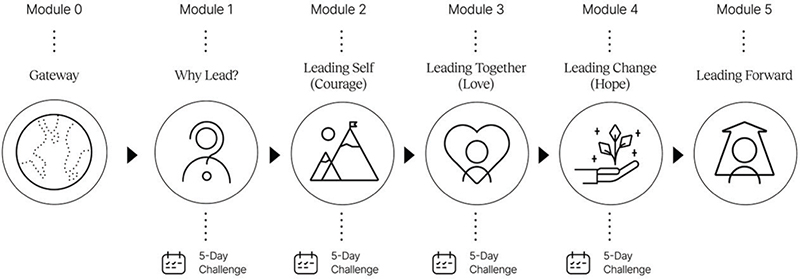
Figure 1
Leading with Character Course Structure
The course integrates theory and practice through thematic modules, each combining interactive learning with a 5-day practical challenge. These exercises require about 20 minutes daily and include reflective journaling and real-world application. For example, in the “Why lead?” module, participants reflect on past leadership struggles to identify strategies that can help them renew purpose and apply these insights to their current leadership contexts. The courage module includes tasks such as supporting colleagues through leadership challenges and developing actionable steps to overcome fear and anxiety in order to address situations where they might otherwise withdraw or remain silent. The hope module invites participants to create a “hope journal” and compile a “playlist for hope,” selecting music or creative materials to nurture positivity and resilience. This structure enables participants to better understand the nature and importance of leadership virtues while building the moral muscles to apply them effectively in their unique contexts.
Designed for a global and diverse audience, the course encourages participants to embrace leadership opportunities in their local contexts while connecting with a wider community of leaders who can offer advice and encouragement. Developed collaboratively by a global team of academics and practitioners from countries including Afghanistan, Bangladesh, China, France, Kenya, Mexico, Nigeria, Trinidad and Tobago, the UK, and the USA, the course draws on expertise in leadership studies, virtue ethics, business, education, sustainable development, and social impact. For example, Adeyinka Adewale, Associate Professor of Leadership Ethics and Entrepreneurship at Henley Business School, explores courage as critical for organizations combating systemic corruption. Carlos Danel, founder and Board Chairman of Gentera, a financial services company in Mexico, shares his experience to demonstrate how purpose-driven leadership can address societal issues by expanding financial inclusion for underserved communities in Latin America.
The course integrates understandings and approaches to leadership from various cultural traditions and includes a range of role models to emphasize the importance of leading in a way that is suited to the context. For instance, Adewale (2024) explores the Yorùbá concept of Omoluabi in West African culture, which emphasizes virtues such as honesty, diligence, loyalty, wisdom, and self-control. This concept frames character as a lifelong journey, nurtured through learning at home and from elders. In this tradition, morally competent individuals act as role models, imparting wisdom and virtues to younger generations. Participants also engage with inspiring contemporary exemplars, such as Pete Reed, an Olympic rower who embodies hope and courage in his approach to life and leadership through the severe challenge of paralysis that has left him unable to walk, and Lina Tori Jan, a policy officer and advocate who elevates and supports Afghan refugee women leaders by equipping them with the essential resources needed for effective advocacy. By weaving together such narratives, the course encourages participants to align their leadership with their personal, cultural, and professional contexts, fostering meaningful and transformative change.
A Human-Centered Approach
The Leading with Character course places character at the heart of leadership development, framing it as the foundation of ethical, effective, and contextually adaptive leadership. Character is defined as a set of enduring habits and dispositions that shape how individuals think, feel, and act (Kristjánsson, 2017; Snow, 2010). This approach highlights that good leadership transcends functional capabilities, rooting itself instead in the personal formation of leaders as human beings.
This emphasis on character reflects a growing recognition of its necessity amidst global challenges marked by complexity, precarity, and eroded trust in leaders (Brooks, 2021). These challenges have prompted a paradigm shift from power- and control-driven leadership to values-based and human-centered approaches (Clark et al., 2024). This emerging paradigm emphasizes service, collaboration, and ethical responsibility, recognizing virtues such as humility, hope, and compassion as essential for fostering trust, collaboration, and long-term societal impact. By placing character at the center, the Leading with Character course aligns with this evolving vision of leadership as a service to others, advancing both individual and organizational flourishing.
Research supports the transformative power of character in leadership. Studies demonstrate that character-based leadership enhances team performance, strengthens organizational culture, and contributes to societal outcomes such as corruption prevention and policy implementation (Wang & Brooks, 2023). Leaders with strong character are also associated with increased follower well-being, job satisfaction, and innovation (Cameron et al., 2004; Meyer & Li, 2023; Rea et al., 2023). Practitioners echo these findings. For example, Hubert Joly, former CEO of Best Buy, exemplifies how prioritizing noble purpose and human dignity over profit creates sustainable and impactful organizations (Joly, 2021). These insights reinforce the need for leadership development initiatives that go beyond professional competence to cultivate the moral and intellectual virtues necessary for effective decision-making in complex environments.
The Leading with Character course contributes to this field by providing a structured framework for cultivating character at the core of leadership development. Its design integrates reflective exercises with habit formation, enabling participants to internalize virtues and apply them in diverse contexts. Moreover, the course situates leadership within broader systems of cultural, social, and organizational influence, encouraging participants to consider how their practices align with the values and traditions of their communities while engaging with global perspectives. This approach acknowledges that good leadership must be contextually adaptive and culturally sensitive. By fostering an understanding of character as both an individual and relational construct, the course empowers leaders to create meaningful impact within their spheres of influence.
Pedagogical Framework: Integrating Theory and Practice
The Leading with Character online course integrates teaching with practical application to develop leadership virtues through intentional practice. It draws on the OCP’s seven research-based strategies for character and leadership development (Lamb et al., 2022): (1) habituation through practice, (2) reflection on personal experience, (3) engagement with virtuous exemplars, (4) dialogue that increases virtue literacy, (5) awareness of situational pressures and biases, (6) moral reminders, and (7) friendships of mutual accountability. These strategies are embedded throughout the course, offering a robust and cohesive framework for fostering sustained character growth (see Figure 2).
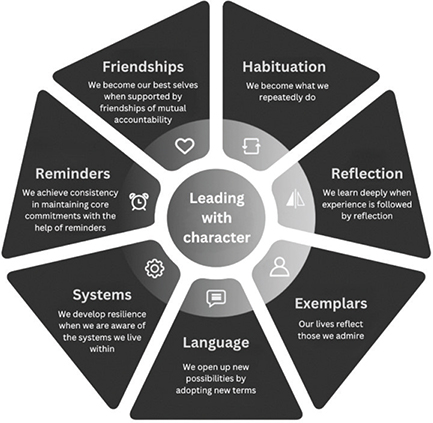
Figure 2
Seven Strategies for Character Development, based on Lamb et al. (2022)
Habituation Through Practice
Central to the course is the idea that character is developed through its repeated enactment, grounded in the Aristotelian view that virtues are habits that are cultivated through consistent and intentional practice. Virtues develop as individuals repeatedly engage in appropriate thoughts, emotions, and actions, gradually internalizing these behaviors until they become second nature (Lamb et al., 2022). This idea parallels mastering a craft, musical instrument, or sport such as golf where mindful and intelligent practice refines skills over time (Annas, 2011). Learners undertake 5-day challenges at the end of each module, encouraging them to practice virtues repeatedly in real-world contexts. For example, in the courage module, participants identify a challenging situation and take deliberate steps to address it over several days, building moral courage through specific and repeated actions.
Reflection on Personal Experience
Reflection is a second key component of character development included in the course, enabling participants to critically evaluate their leadership journeys and deepen their self-awareness. Reflection helps participants assess their existing character traits, identify areas of development, and monitor progress over time (Lamb et al., 2022). In the course, reflective journaling prompts, such as “What does leadership mean to you?” and “What values have shaped your decisions so far?” guide participants to articulate their personal philosophies and identify areas for growth. This structured approach fosters introspection and helps cultivate practical wisdom—the capacity for moral discernment and deliberation necessary for ethical and contextually appropriate action (Brooks, 2025).
Engagement with Virtuous Exemplars
Virtuous exemplars serve as powerful sources of inspiration and learning. Reflecting on such exemplars—whether historical figures, contemporary leaders, or personal mentors—helps to elevate moral vision, reshape moral imagination, and deepen motivation for ethical leadership (Lamb et al., 2022; Miller, 2017). The course features diverse stories of leadership, ranging from CEOs and former Olympic athletes to school teachers and refugee advocates. Exercises enable learners to engage in reflective admiration, critically analyzing the habits and principles exemplified by role models in order to discern how the virtues demonstrated by exemplars can be adapted to their unique contexts (Zagzebski, 2017). Beyond well-known figures, the course encourages participants to identify personal exemplars from their own experiences, recognizing that relatable role models often have the most profound influence (Han et al., 2022).
Dialogue that Increases Virtue Literacy
The course emphasizes the role of dialogue in shaping moral understanding and leadership practices. Drawing from Aristotelian and Socratic traditions, dialogues foster virtue literacy by encouraging participants to engage in discussions about the meaning, importance, and development of virtues (Brooks, 2025; Kristjánsson, 2014; Lamb et al., 2022). The course includes learning materials from diverse cultural and philosophical traditions to broaden perspectives and has discussion forums encouraging participants to share their opinions and learn from each other. By developing a vocabulary of virtues and engaging with diverse cultural frameworks, participants gain clarity in articulating concepts such as love and hope, enabling them to articulate and enact virtuous leadership.
Awareness of Situational Variables
Leadership occurs within complex cultural, social, and organizational systems, and the course emphasizes the importance of understanding and responding to situational variables that may shape both our character and the kind of leadership required. While situational pressures influence behavior, they do not negate the importance of character (Miller, 2014). Instead, developing awareness of biases, incentive structures, and other institutional and relational influences enables leaders to identify and counteract pressures that may undermine important virtues of character (Lamb et al., 2022; Miller, 2017). The course encourages participants to critically assess how their leadership practices align with community values while remaining aware of systemic biases and constraints. The course also highlights the role of leaders in shaping organizational systems. Activities are designed to help participants foster organizational cultures that promote ethical behavior and collaboration, demonstrating how individual virtues can influence broader systems.
Moral Reminders
Moral reminders are tools to sustain character development, reinforcing participants’ commitments and aligning their actions with their moral identity. Research shows that reminders, such as signing an honor pledge or recalling ethical principles, can significantly reduce unethical behaviors (Mazar et al., 2008). This course incorporates email prompts to encourage participants to remain focused on their goals and integrate virtuous habits into their daily routine. Additionally, participants are encouraged to identify reminders that resonate personally and are provided with examples and guidance as to how they might deploy them.
Friendships of Mutual Accountability
Finally, character development flourishes in the context of supportive and meaningful friendships. The course emphasizes friendships of mutual accountability as vital to character development. Inspired by Aristotle’s view of friendship as central to virtue cultivation, these relationships provide mirrors for reflection, feedback, and mutual encouragement (Kristjánsson, 2022). In the course, participants engage with peers through discussion forums to exchange diverse perspectives. These interactions provide opportunities for mutual learning, creating a collaborative environment for sustained growth and a global community of like-minded leaders. Beyond the course, a global alumni network supports continued growth and shared commitment to character-based leadership.
Thematic Modules
Purpose
Defined as a forward-looking intention to achieve goals meaningful to oneself and beneficial to the common good (Damon et al., 2003), purpose connects personal values with broader societal needs. It provides clarity, motivation, and resilience, empowering leaders to inspire others and address challenges with integrity and vision. Research has shown that purpose enhances well-being, strengthens resilience, and improves organizational performance (Hill et al., 2016; Lleo et al., 2019; McKnight & Kashdan, 2009).
This module frames purpose as a virtue of character that is cultivated through reflection and practice. Journaling prompts such as “Why do you lead?” and “What are the most meaningful aspects of your life?” encourage participants to deepen self-awareness. A 5-day challenge translates these reflections into concrete steps, including reflecting on leadership moments and encouraging others. Purposeful leadership also transcends personal ambition, fostering shared goals and collective well-being. The course emphasizes the relational dimension of purpose, encouraging participants to act as catalysts for positive change within their communities and beyond by connecting their individual aspirations with societal challenges.
Courage
Courage is presented as an essential leadership virtue, enabling leaders to act with integrity and overcome challenges. Courage is more than boldness; it involves aligning actions with core values despite fear, resistance, or failure. The course also highlights the interplay between courage and humility. Courage empowers leaders to take decisive action, face fears, and uphold their values even under pressure. Humility, on the other hand, ensures that this courage is tempered by self-awareness and openness to growth.
Leadership exemplars play a vital role in the courage module. By reflecting on the actions and values of public figures such as Nelson Mandela and personal exemplars from their own experience, participants gain insights into how courage manifests in leadership. For example, Mandela’s perseverance during imprisonment and his commitment to reconciliation upon release exemplify how courage can foster trust and drive change (Mandela, 2008). Verónica Fernández, Director of the Virtue and Values Education Centre at Universidad Francisco de Vitoria, shares the story of Diana, a rural teacher in Mexico, whose leadership journey is grounded in introspection, humility, and deep listening. Diana’s leadership catalyzed collaborative projects across 475 middle schools, improving education for thousands of children. Participants are encouraged to identify role models from their own lives, analyzing the qualities that make their leadership courageous. This reflective process helps participants connect abstract concepts to real-world examples, deepening their understanding of how courage can be adapted to different contexts.
Love
Leadership is inherently relational. The course introduces the concept of “generative love” as a relational virtue essential to leadership. Distinct from romantic or sentimental love, generative love is rooted in the intention to seek the flourishing of others and actions that are focused on advancing their well-being, creating trust, and fostering personal and organizational growth (Lee, 2022).
Generative love shifts power dynamics from dominance (“power-over”) to partnership (“power-with”). Leaders who embody this virtue create psychological safety, allowing team members to communicate openly, solve problems collaboratively, and learn from setbacks. Research highlights how such environments promote innovation and resilience, enabling organizations to thrive under pressure (Edmondson & Lei, 2014).
The love module equips participants to integrate generative love into their leadership practices through reflective exercises, role model analysis, and practical exercises like active listening, expressing gratitude, and supporting team members. For example, “thinking pairs” exercises enhance listening abilities (Kline, 1999), while “giver strategies” encourage proactive engagement in empowering others (Grant, 2013).
Hope
The course highlights hope as a core leadership virtue, defining it as the disposition to envision a better future and commit to achieving it despite challenges and uncertainty. Hope is not passive optimism but an active and sustained effort to maintain resilience, overcome despair, and motivate others toward shared goals. It enables leaders to focus on opportunities amidst adversity, fostering a sense of possibility that unites teams and communities in the pursuit of meaningful change.
While hope inspires a vision for a brighter future, practical wisdom helps leaders discern the best course of action, balancing competing priorities and contextual complexities. For instance, a leader might rally a team to address systemic challenges by articulating a hopeful vision while using practical wisdom to navigate obstacles and identify realistic solutions.
This module helps participants distinguish hope from optimism, explore its relational dimensions, and engage with exemplars who exemplify hope in action. Through journaling and discussion forums, participants examine personal barriers to hope and identify strategies to foster it within their teams. The module concludes with a 5-day challenge, where participants apply hope in actionable ways. Exercises include crafting hope-filled narratives, identifying sources of hope, and developing strategies to sustain it. For example, participants write a letter to their future selves, setting goals and envisioning how to overcome obstacles, anchoring their leadership in a hopeful mindset.
Pilot Phase
The pilot phase of Leading with Character was conducted between March and April 2024 to evaluate the course’s content, structure, and usability. A total of 37 participants from diverse cultural, professional, and leadership backgrounds participated, representing both seasoned leadership experts and those new to character-based leadership. This diversity ensured a comprehensive evaluation of the course’s design and impact.
Participants offered positive feedback on the course’s emphasis on character virtues, its academic rigor, and the range of learning resources provided. The integration of practical exercises with reflective prompts and real-world examples was particularly valued for its ability to bridge theoretical concepts with actionable leadership practices. Additionally, the course was commended for its potential to inspire and equip leaders globally. Constructive feedback identified minor areas for refinement, aimed at further enhancing the course’s effectiveness and accessibility across diverse contexts. To further evaluate its effectiveness, a research project is underway to examine its impact among university students worldwide, providing valuable insights into its influence across varied settings.
Conclusion
The Leading with Character online course represents a human-centered approach to leadership development, placing the cultivation of character at the core of effective and ethical leadership. In today’s increasingly complex and interconnected world, the course addresses the pressing need for leaders who can effectively navigate challenges with wisdom, integrity, and a commitment to the common good. By combining theoretical insights with hands-on exercises, the course fosters the development of essential virtues such as purpose, courage, love, and hope, equipping participants with both the mindset and practical tools needed to lead with impact.
The course’s structured modules and experiential learning approach guide participants to reflect on their leadership journeys, cultivate virtues, and drive meaningful change in their communities and organizations. As the course evolves, its long-term vision is to develop a worldwide network of leaders committed to advancing societal flourishing through character-based leadership. By prioritizing virtues and fostering collaborative action, Leading with Character aspires to contribute in a small but meaningful way to the transformation of organizations, communities, and the broader global context.
Acknowledgments
The authors would like to extend their thanks to Juliette Ash and Colin Webb for their invaluable administrative and technical support throughout the development of the Leading with Character course. We also wish to express our gratitude to our course development partners, whose expertise and collaboration were integral to the course design and build: Miguel Amigot, Ashlynn Brown, and the entire team at IBL Education; Angela Adams, Celeste Bruwer, John Jeppsson, and the team at Construct; and Kit Debuse and Joe Russell at Land of Plenty.
The development of the Leading with Character online course was generously funded by the Legatum Foundation. Additionally, this article and the research into the efficacy of the Leading with Character course were made possible through funding from the Templeton World Charity Foundation. The opinions expressed in this article are those of the authors and do not necessarily reflect the views of the Legatum Foundation or the Templeton World Charity Foundation.
References
| Adewale, A. (2024). Courage: An ethico-sociological analysis from the Yorùbá worldview. In B. Fowers (Ed.), The virtue of courage (pp. 125–142). Oxford University Press. |
| Annas, J. (2011). Intelligent virtue. Oxford University Press. |
| Brooks, E. (2021). A new generation of wise thinkers and good leaders. Journal of Character and Leadership Development, 8(2), 32–44. |
| Brooks, E. (2025). [Forthcoming]. Leadership and character development in universities. In E. Barrett (Ed.), Character and leadership development. Naval Institute Press. |
| Brooks, E., Park, R., & Sarker, A. (2024). The Oxford character project. In M. D. Matthews & R. M. Lerner (Eds.), The Routledge international handbook of multidisciplinary perspectives on character development (Vol. II, pp. 325–340). Routledge. |
| Cameron, K. S., Bright, D., & Caza, A. (2004). Exploring the relationships between organizational virtuousness and performance. American Behavioral Scientist, 47(6), 781. https://doi.org/10.1177/0002764203260209 |
| Clark, K. B., Clark, J. R., & Clark, E. E. (2024). Leading through: Activating the soul, heart, and mind of leadership. Harvard Business Review Press. |
| Damon, W., Menon, J., & Cotton Bronk, K. (2003). The development of purpose during adolescence. Applied Developmental Science, 7(3), 119–128. https://doi.org/10.1207/S1532480XADS0703_2 |
| Edmondson, A. C., & Lei, Z. (2014). Psychological safety: The history, renaissance, and future of an interpersonal construct. Annual Review of Organizational Psychology and Organizational Behavior, 1(1), 23–43. https://doi.org/10.1146/annurev-orgpsych-031413-091305 |
| Grant, A. (2013). Give and take: Why helping others drives our success. Viking. |
| Han, H., Kim, J., Jeong, C., & Cohen, G. L. (2017). Attainable and relevant moral exemplars are more effective than extraordinary exemplars in promoting voluntary service engagement. Frontiers in Psychology, 8, 283. https://doi.org/10.3389/fpsyg.2017.00283 |
| Hill, P. L., Burrow, A. L., & Bronk, K. C. (2016). Persevering with positivity and purpose: An examination of purpose commitment and positive affect as predictors of grit. Journal of Happiness Studies, 17(1), 257–269. https://doi.org/10.1007/s10902-014-9593-5 |
| Joly, H. (2021). The heart of business: Leadership principles for the next era of capitalism. Harvard Business Press. |
| Kline, N. (1999). Time to think: Listening to ignite the human mind. Cassell Illustrated. |
| Kristjánsson, K. (2014). On the old saw that dialogue is a Socratic but not an Aristotelian method of moral education. Educational Theory, 64(4), 333–348. https://doi.org/10.1111/edth.12065 |
| Kristjánsson, K. (2017). Aristotelian character education. Routledge. |
| Kristjánsson, K. (2022). Friendship for virtue. Oxford University Press. |
| Lamb, M., Brant, J., & Brooks, E. (2022). Seven strategies for cultivating virtue in the university. In J. Brant, E. Brooks, & M. Lamb (Eds.), Cultivating virtue in the university (pp. 115–156). Oxford University Press. |
| Lee, M. T. (2022). Love as a foundational principle for humanistic management. In M. Pirson (Ed.), Love and organization (pp. 5–38). Routledge. |
| Lleo, A., Rey, C., & Chinchilla, N. (2019). Measuring the purpose strength. In C. Rey, M. Bastons, & P. Sotok (Eds.), Purpose-driven organizations (pp. 119–130). Palgrave Macmillan. |
| Mandela, N. (2008). Long walk to freedom: The autobiography of Nelson Mandela. Hachette UK. |
| Mazar, N., Amir, O., & Ariely, D. (2008). The dishonesty of honest people. Journal of Marketing Research, 45(6), 633–644. https://doi.org/10.1509/jmkr.45.6.633 |
| McKnight, P. E., & Kashdan, T. B. (2009). Purpose in life as a system that creates and sustains health and well-being: An integrative, testable theory. Review of General Psychology, 13(3), 242–251. https://doi.org/10.1037/a0017152 |
| Meyer, M., & Li, T. (2023). Can good information prevent misconduct? The role of organizational epistemic virtues for ethical behavior. Journal of Business Ethics, 197(3), 489–504. https://doi.org/10.1007/s10551-024-05796-8 |
| Miller, C. (2014). Character and moral psychology. Oxford University Press. |
| Miller, C. (2017). The character gap: How good are we? Oxford University Press. |
| Rea, P., Stoller, J. K., & Kolp, A. (2023). Better humans, better performance: Driving leadership, teamwork, and culture with intentionality (p. 175). McGraw Hill. |
| Snow, N. E. (2010). Virtue as social intelligence: An empirically grounded theory. Routledge. |
| University of Oxford. (n.d.). Education strategic plan 2018–24. https://www.ox.ac.uk/about/organisation/strategic-plan-2018-24/education |
| Wang, W., & Brooks, E. (2023). Character and global leadership. Oxford Character Project, University of Oxford. https://oxfordcharacter.org/research/character-global-leadership-report-2023 |
| Zagzebski, L. (2017). Exemplarist moral theory. Oxford University Press. |