RESEARCH
Character in English-Language Military Leadership Doctrine
H. Christian Breede, Canadian Defence Academy, Department of National Defence
Mary Crossan, Ivey Business School, Western University
ABSTRACT
Background: Character is widely recognized as a critical aspect of individual and group performance, and character’s applicability to the military is no exception. Character serves as an explicit entry requirement, a desired outcome within training institutions, and a focal point of emphasis across various military organizations.
Objective: This article examines how character is discussed within military leadership doctrine and how it is framed. More specifically, how has “good character” been understood and measured?
Methods: This study examined the leadership doctrine of six English-speaking militaries using the Leader Character Framework (LCF), a framework developed in recent leadership scholarship, to identify the dimensions of character that are emphasized. This examination is carried out using a simple quantitative analysis technique, using the keywords in the LCF as specific recording units.
Results: The findings revealed that while the six militaries identified similar character dimensions, they also displayed a lack of emphasis on several important dimensions, which could lead to character imbalances. Research on the LCF suggests that such imbalances can manifest in vices of deficiency or excess, rather than the intended virtuous state.
Conclusions: This study offers several avenues for further research and highlights specific aspects of character that should be reinforced and emphasized to enhance military leadership.
Keywords: character, leadership, doctrine, military, anglosphere
Citation: Journal of Character and Leadership Development 2026, 13(1): 339. https://doi.org/10.58315/jcld.v13.339
Copyright: © 2026 The author(s)
This is an open-access article distributed under the terms of the Creative Commons Attribution 4.0 International License (https://creativecommons.org/licenses/by/4.0/), which permits unrestricted use, distribution, and reproduction in any medium, provided the original author(s) and source are credited, a link to the license is provided, and any changes made are indicated.
CONTACT: H. Christian Breede christian.breede@forces.gc.ca
Published: 09 April 2026
Character in Military Leadership Doctrine
A strong character is one that will not be unbalanced by the most powerful emotions.
(Clausewitz 3.I)
While character has received considerable academic attention of late (Crossan et al., 2024c) as well as popular mention (McChrystal, 2025), it has long been a term that is referenced, invoked, and aspired to by many militaries (Australian Defence Force, 2023; Department of the Army, 2018; Queen’s Regulations and Orders, 2024; Von Clausewitz, 1976). However, while the term “character” is used, it is rarely systematically defined and operationalized in a military setting. An exception to this trend, however, is recent work by Crossan and her colleagues (Crossan et al., 2017), which presents an opportunity to assess the state of character as it is presented in military doctrine.
For this study, we employ the definition of character as offered by Crossan et al. (2024b), and we reproduce the definition here in full, with character defined as:
an interconnected suite of embodied and virtuous habits. These habits are virtuous insofar as they collectively influence judgment and human flourishing. The dimensions of character can be observed, assessed, and developed. Character is universal, yet reflexive to context and can manifest toward deficient or excess vices when high levels of one dimension are not supported by high levels of other dimensions. (p. 653)
Several key components of this definition are important to highlight. First, this definition emphasizes the importance of balance, both within an individual dimension and between dimensions. This view of character is rooted in the ancient Greek concept of the virtuous or golden mean (Aristotle, 2001), in which any dimension can become problematic when it falls out of balance with other dimensions. Second, it emphasizes that character dimensions can be observed, assessed, and, more importantly, developed through intentional practice that emphasizes awareness (Niemiec, 2006). While universal, the dimension of judgment, which Aristotle viewed as “practical wisdom,” means that character is exercised in a specific context. In this study, we rely on the Leader Character Framework (LCF) developed by Crossan et al. (2017) because it satisfies all aspects of the definition. Specifically, we ask how character and, more precisely, “good character,” have been understood and measured within leadership doctrine?
To address this research question, we conducted a content analysis of leadership doctrine from Canada, the United States, the United Kingdom, Australia, New Zealand, and the Republic of Ireland. We used the LCF to compare the emphasis on character dimensions in leadership doctrine, and the study reveals how unevenly character has been treated across these cases. Given the imbalances in emphasis across dimensions, the LCF suggests implications for how virtues of character can manifest as vices when not supported by other dimensions, and it points to opportunities to consider more robust approaches to employing character in the military.
We begin by examining the literature on leader character in workplace settings, focusing on its military application and how it has been measured in terms of a military’s doctrinal foundation. We then outline the theory and method guiding the research, which includes a description of the LCF and its application in conducting the content analysis of 19 leadership doctrine publications. We conclude by providing recommendations for policy and doctrinal development to address the character imbalance in leadership doctrine.
Military Doctrine and Leader Character
Military doctrine describes assumptions, routines, concepts, and practices to be passed on (Høiback, 2013; McKitrick and Chiarelli, 1984). Doctrine is at once a tool for command, a tool for education, and a tool for change. As a tool for command, doctrine defines what to do, and as a tool for education, doctrine explains why. Lastly, as a tool for change, doctrine describes what is to be (Høiback, 2013, p. 157).
Within the body of literature considered “doctrine,” a hierarchy exists. Certain doctrinal publications will create the framework for subsequent, subordinate doctrine. Known as boss texts (Breede and Coombs, 2024; Taber, 2009), these volumes form the “ideological code of the dominant narrative” (Taber, 2009, p. 30). For example, Canadian boss texts include Trusted to Serve (2022) and Fighting Spirit (2024), both of which articulate an ethos and understanding of the profession of arms from which all subsequent Canadian Armed Forces (CAF) doctrine flows (Breede and Coombs, 2024). Common-level doctrine applies to all branches and services within a given organization. In contrast, service-level doctrine is written by and for a particular service, like an army, navy, or air force (Breede and Coombs, 2024).
Character and the Military
In Western philosophy, character is most often associated with the ancient Greeks through the concept of virtue (Mordacci, 2021). Additionally, it has its origins in Confucian thought (Wang and Hackett, 2015). Moreover, the concept of character as virtue has parallel origins in Taoist, Buddhist, Hindu, Islamic, and Judeo-Christian thought (Peterson and Seligman, 2004). Character as virtue can also be found within the Seven Sacred Teachings of Indigenous communities in North America (Department of National Defence [Canada], 2024).
Although character has received consistent philosophical treatment, much of that understanding has been disconnected from practice. Character is generally viewed in terms of ethics, morality, and overall trustworthiness, and is often perceived as something people either possess or lack. Moreover, a gap has existed between research and practice, leaving practitioners without a structured and coherent approach to understanding, developing, and embedding character in organizations (Crossan et al., 2024a). More recently, definitions and concepts have coalesced around the idea that character is about virtue and habit (Crossan et al., 2024a; Peterson and Seligman, 2004; Rea et al., 2023).
While character has a long tradition in military organizations, it is often treated as an emergent concept, the result of arduous shared experience or something innate. For example, the United States Military Academy at West Point (USMA) has a long-held vision to “educate and inspire leaders of character” (Department of the Army, 2018), while the CAF clearly articulates “strength of character” as one of its five entry requirements into the service (Queen’s Regulations and Orders, 2024). And yet, how character is both assessed and developed is addressed indirectly. Character is often referenced but rarely discussed; instead, it is assumed (Boe et al., 2015; Ender, 2008; Queen’s Regulations and Orders, 2024; Shay, 1994).
Research supports the idea that character is multifaceted, composed of virtues (Peterson and Seligman, 2004; Rea et al., 2023) or dimensions and elements (Crossan et al., 2017). It reveals that character can not only be measured (Damian et al., 2019; Park and Peterson, 2006), but it can also be developed (Crossan and Crossan, 2023; Peterson and Seligman, 2004; Rea et al., 2023). Finally, consistent with the character definition, it reinforces that any virtue can operate as a vice when not supported by the other dimensions.
While broadly consistent with other frameworks (Peterson and Seligman, 2004; Rea et al., 2023), the LCF (Figure 1) emphasizes the interconnected nature of the character dimensions, which reveals the importance of balance as a key aspect of character strength. Indeed, each dimension influences the other, with strength in one dimension potentially manifesting in excess when not supported by other dimensions. For example, strong courage can manifest as recklessness when not supported by temperance and humility. The remedy is not to reduce a strength, but to strengthen the weaker dimensions (Crossan and Crossan, 2023).
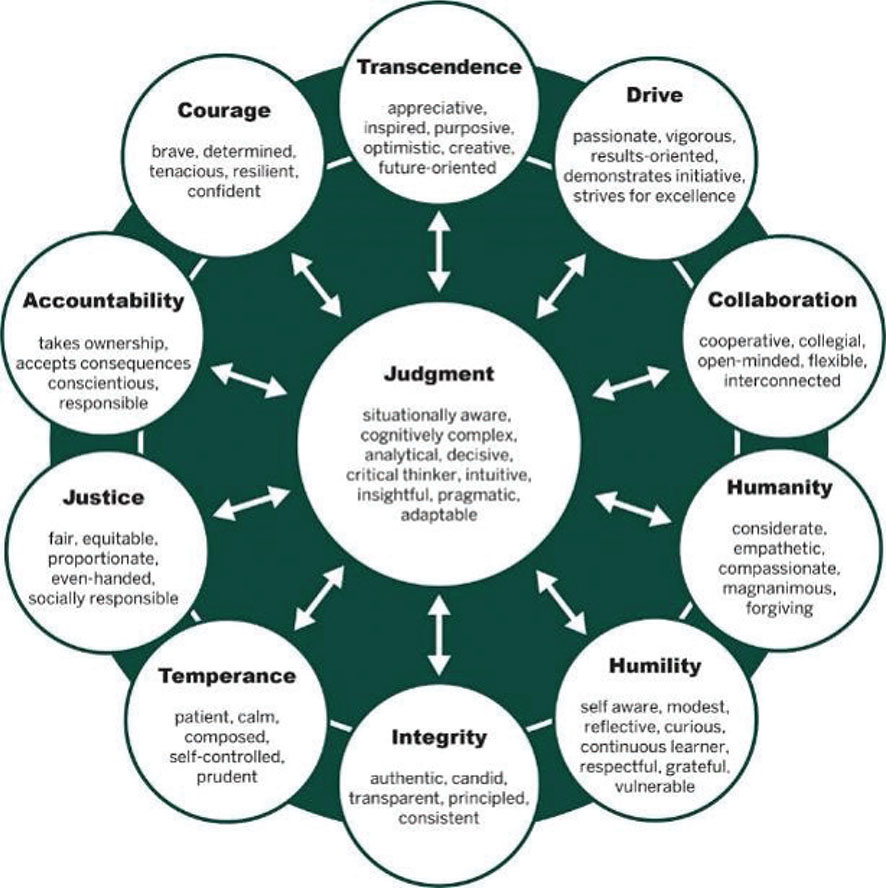
Figure 1
Leader Character Framework (Crossan et al., 2017)
We employ the LCF developed by Crossan et al. (2017) for several reasons. First, it offers a robust theoretical and empirical framework that builds upon and incorporates insights from other frameworks, such as Peterson and Seligman (2004) and Niemiec (2006). Second, the LCF bridges theory and practice through the method known as engaged scholarship. Thirdly, it focuses on observable behavior, whereas the Peterson and Seligman (2004) approach includes items that relate to intention, not just observable behavior. Because intentions are not observable, intentions alone are insufficient. Therefore, it is important to focus only on those behaviors that can be observed in character assessment.
Finally, whereas Peterson and Seligman (2004) and Niemiec (2006) treat character strengths as independent, the interconnected nature of the dimensions, centered on judgment, is a key concept. The LCF creates a character architecture whereby imbalances that would otherwise lead to vices are, in fact, simply dimensions that are unsupported by other underdeveloped dimensions (Crossan et al., 2017).
Methodology
This study analyzes the highest levels of leadership doctrine across six English-speaking countries. In some cases, leadership doctrine was held at the common level, meaning that the leadership doctrine applied equally to all services or branches of the armed forces. In other countries, such a common-level doctrine does not exist; in these cases, our analysis focuses on the different service-level doctrines that are available. A total of 19 publications from six countries were examined.
Within the countries examined, leadership doctrine was approached in three ways. The first, used by the United States and the United Kingdom, left doctrine to individual services, resulting in five U.S. publications, one each for the Marine Corps (2024), Army (2025), Navy (2017), Air Force (2023), and Space Force (2023). While UK doctrines for the British Army (2021) and Royal Air Force (2020) were consulted, we were unable to find any reference to leadership doctrine for the Royal Navy aside from their website. The second approach, used by Australia, involved creating common-level boss texts while allowing services to develop their own doctrines. Australia produced five documents, including the Australian Defence Force (2021, 2023) as well as service-level doctrines from the Army (2002), Navy (2010), and Air Force (2013). The third approach, used by Canada, New Zealand, and Ireland, held doctrine at the common level only, resulting in six texts being examined. These included Canada’s four-volume series (2005–2007), New Zealand Defence Force (2018), and Defence Forces Ireland (2023). The leadership doctrine of the six countries comprises just under 1750 pages across the 19 volumes and ranges in publication dates from 2003 to 2025. Table 1 offers a complete listing of all 19 texts consulted.
Measuring Character
According to the LCF, character comprises 62 elements grouped into 11 dimensions as depicted in Figure 1. Combining the terms Character, Vice, and Virtue, along with the 62 elements and 11 dimensions, yields 76 terms for the content analysis. All occurrences of the terms were verified as being used in the correct context, with noun and verb tense variation leading to several occurrences being discounted and appropriate derivations included.1 Following this control, over 7800 context-correct occurrences associated with character terms were captured. To confirm consistency, we randomly selected documents and re-checked certain terms’ occurrences against the context rules used to confirm and if needed, update counts.
We used quantitative content analysis to identify and analyze the character terms, and the complete results can be found in the data annex to this article. We employed three basic techniques to describe and analyze the data to include frequency, depth, and balance. To analyze balance, we employed a simple graphing technique that visualizes the relative emphasis each of the 11 dimensions of character received, while frequency was simply a raw count. Depth was measured by comparing the frequency of the term character against the frequency of the various elements in each document.
Absolute frequencies represent the total occurrences of particular terms, while relative frequencies represent the normalized score for those terms. Higher frequency values indicate increased emphasis on the term as a character dimension. We elected to normalize all scores to address document lengths (from a few hundred words on a website to several hundred pages in a book). A summary chart is presented in Figure 2.
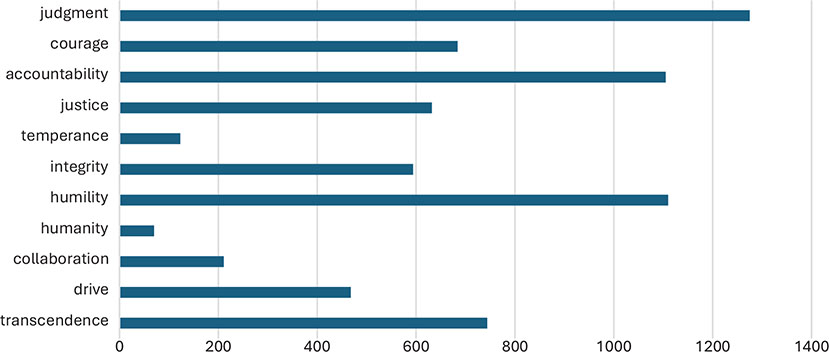
Figure 2
Character Dimension Frequency (All Publications)
To measure depth, we took the ratio of the frequency of the word character against the sum of the frequency of the dimensions and elements. For example, a detailed treatment of character would not only mention character but also a significant number of the character-related dimensions and elements as well. This is represented in Figure 3.
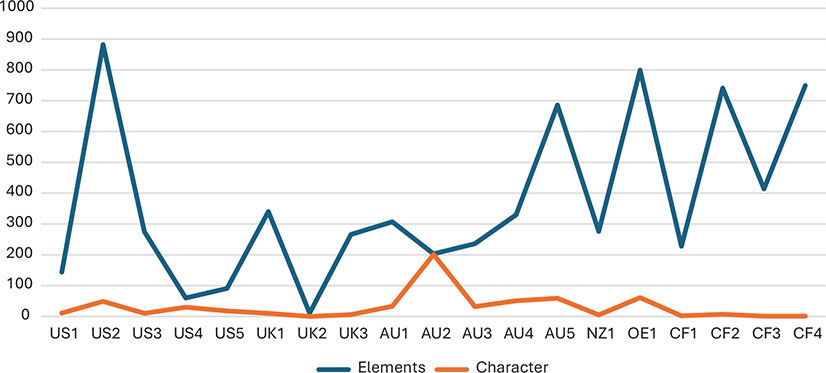
Figure 3
Doctrinal Depth of Character
To measure balance, we created a radar chart for each document, service, and country using the character dimensions as axes. The absolute values of the frequencies were then plotted on each axis, a summary of which is provided in Figures 4 and 5 as a series of character maps for services and militaries as a whole. All doctrinal documents were verified against the most recent publicly available editions as of September 2025. Future updates may alter the results if the analysis is repeated.
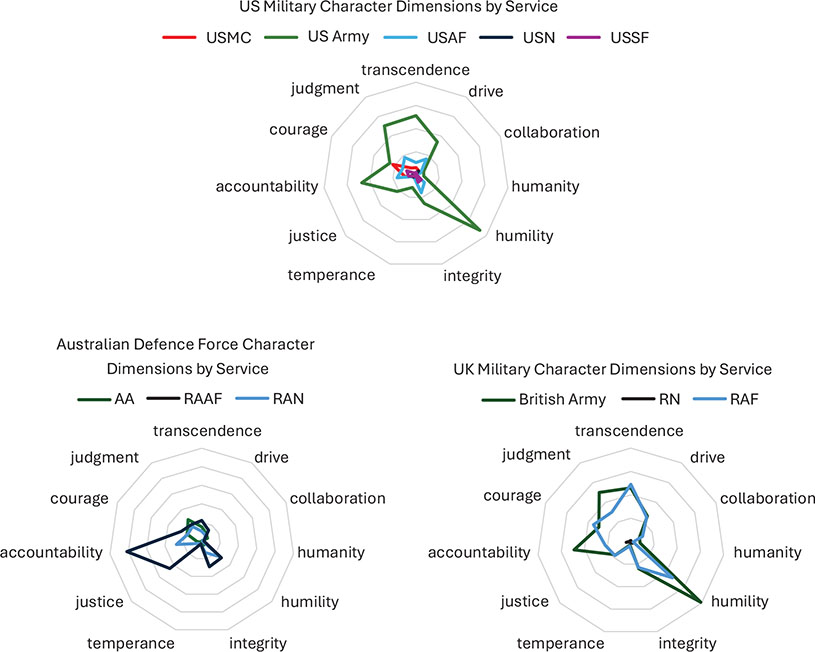
Figure 4
Character Emphasis Maps for Service-Level Doctrine (by Country)
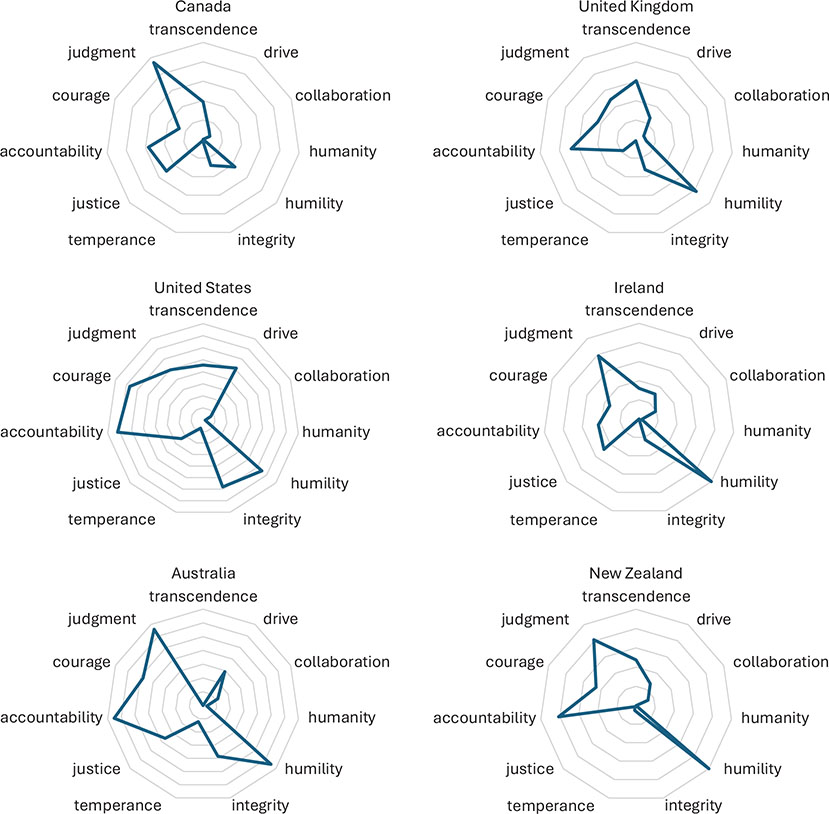
Figure 5
Country-Level Character Emphasis Maps
Scope and Limits
This study employs a content analysis based around the use of keywords as they appear in doctrine in terms of their frequency, depth, and distribution. As a result, there are certain limitations that this method implies. First and foremost, our work captures only that which is articulated in doctrine. It does not capture how well this doctrine is operationalized into training within the formal training and professional military education systems or the informal socialization that occurs within individual unit lines.
This means that the findings and discussions to follow from this study are limited to the idea that what we have captured is simply the authoritative guidance offered by doctrine and is by no means a comprehensive analysis of how militaries enact leader-character. Accordingly, references to potential risks or imbalances should be understood as interpretive implications grounded in theory rather than demonstrated causal effects. However, it is a helpful starting point nonetheless and provides some valuable insight and foundation for further study.
Findings and Discussion
The Basics—Character Frequency
The most frequently mentioned dimension, along with its related elements, was Judgment (1115 occurrences), followed by Accountability (967 occurrences) and Humility (946 occurrences). At the opposite end of the analysis, the three least frequently mentioned dimensions and related elements were Humanity (61 occurrences), Temperance (94 occurrences), and Collaboration (210 occurrences), as shown in Figure 2.
The Basics—Character Depth
A comparison between the frequency of the term Character against the frequency of the dimensions and elements reveals the depth to which character is treated. Figure 3 provides a visualization of this measure for all 19 publications. Table 2 is a sample that illustrates how character depths were measured.
The image in Figure 3 dramatically illustrates the variation in depth associated with the concept of character across the 19 publications. While the frequency of explicit mentions of character is relatively consistent across all but one of the doctrinal publications (Australia’s Character in the Profession of Arms at 201 mentions of character), there is significant variation between the publications regarding the depth to which character is expanded by mentioning dimensions and elements. Documents from the Royal Australian Navy (AU5), the Canadian Armed Forces (CF2), and the Irish Defence Force (OE2) appear to delve into the details surrounding character, while others, such as publications from the US Navy (US4) and the Royal Navy (UK2), provide less depth. Interestingly, while the four volumes from Canada (CF1–4) make almost no mention of the term character itself, they do extensively mention terms associated with the elements and dimensions of character.
Interestingly, US military publications are relatively thin on character when compared with the other five countries examined. Also notable is the almost complete absence of character discussion in the Royal Navy’s publication. However, this is likely attributable to the fact that their leadership doctrine is absent, with the exception of some references to leadership principles found on their website. Setting aside the Royal Navy, the remainder of the UK character doctrine we reviewed is consistent in its pattern of emphasis across character dimensions.
The Emphasis Maps—Character Balance
We combined the various service and common-level publications by country and mapped the context-corrected occurrences according to their 11 dimensions. We then presented this mapping by publication and country. Figure 4 is a collection of radar graphs that illustrate the character map for each publication, in the cases where individual services provided their own leadership doctrines.
The maps suggest an imbalance of character across all service-level publications. Notably, the UK and US share similar profiles, with a strong emphasis on Humility in both the US Army and the British Army. Additionally, we observe a cluster of Transcendence, Judgment, and Accountability in both the UK and US land components. Australia is unique in its emphasis upon Accountability and Justice within its Navy. All services, across all three countries, place little emphasis upon Collaboration, Humanity, and Temperance. Lastly, the relatively thin treatment of character in the Australian Army is notable as well, especially when compared to the UK, where the British Army and Royal Navy have an opposite relationship in terms of character emphasis compared to the Australian Army and Royal Australian Navy.
These findings allow us to conclude that the service-level doctrine in the US, UK, and Australia treats character in an unbalanced manner. Because the theory of leader character cautions that character imbalance through weak (dimensions in a deficit state) or unsupported (dimensions in an excess state) dimensions is an indicator of inconsistent or even risky leader behavior (Crossan et al., 2024c, p. 58), this is a notable finding.
Examining the dimensions for each country, we compiled the individual service-level doctrine results and included the common-level doctrine (where applicable) to create a single measure of character for each country and applied the same radar graphing technique. Again, this analysis reveals striking consistencies as well as curious outliers.
First, Canada’s leadership doctrine is unique in that it does not share the emphasis upon Humility that we see in the other five countries. Additionally, the Judgment-Accountability-Transcendence cluster appears to be unique to the UK, US, and Australia, with both Canada and New Zealand downplaying the importance of Courage and Transcendence. However, Judgment remains a central focus for all six countries. Finally, Australia, Ireland, and Canada all share relative strengths in the dimension of Justice.
Perhaps unsurprisingly, but no less of a concern, is the underemphasis upon the character dimension of Humanity across all six countries. Given the nature of the profession of arms, which involves preparing for and engaging in the brutal process of warfighting, it may explain the underweighting of Humanity. However, this interpretation would be shortsighted. Whether in combat or collaboration, weaknesses in Humanity can compromise Judgment. In combat, it is essential to be able to regulate strong Humanity with Justice and Accountability, as instances of low Humanity can lead to egregious situations of failures in Judgment, such as those that might lead to violations of the laws of armed conflict or unethical behaviour.
Failures in judgment, however, need not be limited to warfighting to be of significance to the profession of arms. Canada’s recent experience with its long-running challenge of sexual misconduct within the ranks is a compelling, non-combat example. Between 2020 and 2023, two consecutive Chiefs of the Defence Staff (the highest-ranking member of the military in Canada) were removed from their positions due to allegations of sexual misconduct. Additionally, several other high-ranking general and flag officers faced similar accusations (Burke and Brewster, 2023) and stepped down. While these senior officers caused tremendous harm to their victims, they also harmed the institution and demonstrated a profound lack of judgment as individual leaders. Strength of character matters all the time. While character has yet to be incorporated into CAF leadership doctrine (Department of National Defence, 2005a, 2005b, 2007a, 2007b), it now features centrally in the recent Profession of Arms doctrine (Department of National Defence, 2022, 2024). This new emphasis on character is a direct result of these recent experiences with failures in judgment.
The underemphasis of Humanity, Temperance, and Collaboration across all six countries suggests another area for potential development. Also of interest is the almost universal underemphasis of Courage and Collaboration. In all six countries examined, Courage and Collaboration receive far fewer mentions in leadership doctrine than other dimensions and elements. This is not only additional evidence in support of our claim of uneven character development, but also particularly noteworthy given again what militaries are asked to do. Courage and Collaboration would seem to be natural attributes of an effective military, and yet these are relatively absent in these cases.
An underemphasis on the dimension of Courage has implications beyond the battlefield. While it may be that courage – as a general concept – is fundamental to the military in the context of close combat, this assumption does run the risk of overlooking the important role of courage in day-to-day interactions that constitute much of the experience of members of the profession of arms. Courage is more than just demonstrating selflessness under fire; it also involves the willingness to engage in a necessary, yet difficult, conversation with a colleague or to admit to a mistake when it would otherwise be far easier to ignore it.
The underemphasis on the dimension of Collaboration manifests as unhealthy interservice rivalry within a military or through interoperability challenges between militaries in alliances and coalitions. In short, it impedes the ability of a force to work together. While this is somewhat counterintuitive, given that warfighting is a team effort, history is filled with examples of clashing egos (Ricks, 2012, p. 95) and an inability for various services to work together (Hamre, 2016). Emphasizing the importance of collaboration at all levels is an important point that has been overlooked.
Policy Implications
All six countries—even those that devoted considerable effort to explain character and its development—did not recognize the interconnected nature of the dimensions and elements of character, as well as how important the concept of balance is within their various leadership doctrines. As was remarked earlier, focusing on only a few dimensions of character runs the risk of creating unbalanced character, and this is a risk that particular doctrines examined revealed. As our research has reported, strength of character must be balanced to hedge against its potential virtues manifesting as vices.
Just as leader character is most effective when integrated into doctrine, so too will it only result in improved decision-making when it is integrated into what units already do. This means that individuals need to have habituated the awareness, self-reflection, and inner work that encompasses the idea of character development. Moreover, the benefits of character development will only manifest during an operation if the members have put in the time to train and develop their character beforehand. The time to think about developing your character is not when you are in the attack position, immediately prior to H-hour, about to launch an assault on an objective. Instead, like physical fitness, the improved decision-making that comes from character work is the result of “embodied and virtuous habits” (Crossan et al., 2024b, p. 653) that you do before needing to make the decision. The payoff comes from sets and reps.
While this study’s findings reveal some challenges to how character is treated within the six militaries examined, these challenges can also be viewed as an opportunity, as there is clear guidance available through the application of the LCF. Where character dimensions have been under-weighted, there is an opportunity to strengthen those dimensions to avoid the risk that strong dimensions will manifest in a vice state. The advances in character development, such as habit development, relying on exercise science theory and practice (Crossan et al., 2024b), offer innovative approaches to character development.
A key limitation of this study, however (as stated earlier) is that, as the analysis focuses on the doctrine, it does not account for the work being done daily in training institutions and line units. Many of the vulnerabilities identified in this study might have received attention from curious and dedicated leaders devoted to their leadership craft. However, as doctrine provides authoritative guidance for what militaries do and how they do it, the analysis reveals significant gaps, guiding the architecture of character and its development more intentionally and deliberately. Embedding the idea of leader character into doctrine will help militaries get over the temporary bump of cultivating awareness (Crossan et al., 2024c, 2025) to realizing strategic impact, which tends to occur when energetic and well-meaning leaders try to move the proverbial needle in building a positive workplace culture.
Conclusion
Through the analysis of the publications, we observe that certain character dimensions receive greater doctrinal emphasis than others, and more problematically, this selectivity runs counter to recent research on character and character development, particularly work associated with the LCF, which treats underdeveloped or over-weighted dimensions as a potential risk to sound judgment.
In addition, the treatment of character development tends to emphasize informal means, most often viewing character as an emergent or otherwise “as is” component of leadership. Character rarely receives formal (to be both deliberate and intentional) forms of development in doctrine. The findings suggest that doctrine does not consistently reflect the interconnected architecture of character articulated in the LCF.
Because doctrine provides authoritative guidance for professional development, greater intentional integration of balanced character dimensions may strengthen alignment between theory and practice. Future research should examine whether and how these doctrinal patterns translate into training environments and ultimately the behavior of military leaders. Our research indicates that character matters in the military: we consistently found references to both character and the dimensions associated with it throughout the 19 volumes examined. However, without clarity on what character is, how it can manifest in deficient and excess vice states, and how to develop it, we risk compromising judgment and well-being. This study points to a significant opportunity to enhance military leadership by raising these questions. Put simply, our study identifies patterns of emphasis in doctrine, and further work could help make the connection to training and leader development outcomes crystal clear.
Acknowledgments
The authors wish to thank those who provided comments and feedback on this research, including Stéfanie von Hlatky, Seemantini Pathak, Dusya Vera, William Cummings, Guilherme Martinelli, the members of the Ivey Leadership Institute as well as the anonymous peer reviewers and the editorial team of the journal. The study was conducted as part of our regular duties with our primary institutions. The opinions and arguments expressed here are those of the authors and not the official policy of the Government of Canada, the Department of National Defence, or Western University.
References
| Aristotle. (2001). Nicomachean ethics. In R. McKeon (Ed.). The Basic Works of Aristotle (pp. 935–1112). (W. D. Ross, Trans.). The Modern Library. (Original work published ca. 350 B.C.E.). |
| Australian Army. (2021). LWD 0–2 Leadership. Australian Army. https://www.google.com/url?sa=t&source=web&rct=j&opi=89978449&url=https://131acu.files.wordpress.com/2016/11/lwd_0-2_leadership.pdf&ved=2ahUKEwjd16Xy1vSRAxVEM1kFHSf7N9kQFnoECB0QAQ&usg=AOvVaw1dhCq3xtAHwHRRpm1437fZ |
| Australian Defence Force. (2021). ADF-P-0 ADF Leadership (3rd ed.). Australian Defence Force. https://theforge.defence.gov.au/doctrine-audiobooks/adf-philosophical-doctrine-adf-leadership |
| Australian Defence Force. (2023). ADF-P-0 ADF Character in the Profession of Arms. Australian Defence Force. https://theforge.defence.gov.au/doctrine-audiobooks/character-doctrine |
| Boe, O., Bang, H., and Nilsen, F. A. (2015). Experienced military officer’s perception of important character strengths. Procedia—Social and Behavioural Sciences, 190, 339–345. https://doi.org/10.1016/j.sbspro.2015.05.008 |
| Breede, H. C., and Coombs, H. (2024). Canada. In S. Von Felten, P. Hofstetter, and M. Holenweger (Eds.), Military Leadership Concepts: An International Perspective (pp. 63–86). The Swiss Armed Forces. |
| Burke, A., and Brewster, M. (2023, October 21). A military in crisis: Here are the senior leaders embroiled in sexual misconduct cases. CBC News. https://www.cbc.ca/news/politics/sexual-misconduct-military-senior-leaders-dnd-caf-1.6218683 |
| Crossan, C., and Crossan, M. (2023). The practice of developing leader character to elevate judgment. In T. Newstead and R. Riggio (Eds.), Leadership and Virtues: Understanding and Practicing Good Leadership (pp. 210–226). Routledge. |
| Crossan, M., Byrne, A., Seijts, G. H., Reno, M., Monzani, L., and Gandz, J. (2017). Towards a framework of leader character in organizations. Journal of Management Studies, 54(7), 7–29. https://doi.org/10.1111/joms.12254 |
| Crossan, M., Crossan, C., and Furlong, B. (2024a). Cracking the code: Strategic impact of leader character development for competitive advantage. Amplify, 36, 8–17. |
| Crossan, M., Crossan, C., Newstead, T., and Sturm, R. E. (2024b). Developing leader character: Finding a way forward. Academy of Management Learning and Education, 12(2), 1–24. |
| Crossan, M., Furlong, B., and Crossan, C. (2025). Diagnosing and strategically implementing a character-based culture. Leader to Leader, 117, 15–22. https://doi.org/10.1002/ltl.20898 |
| Crossan, M., Seijts, G., and Furlong, B. (2024c). The Character Compass: Transforming Leadership for the 21st Century. Routledge. |
| Damian, R. I., Spengler, M., Sutu, A., and Roberts, B. W. (2019). Sixteen going on sixty-six: A longitudinal study of personality stability and change across 50 years. Journal of Personality and Social Psychology, 117(3), 674–695. https://doi.org/10.1037/pspp0000210 |
| Defence Forces Ireland. (2023). Defence Forces Leadership Doctrine (2nd ed.). DFDM-J2. Defence Forces Printing Press. https://www.google.com/url?sa=t&source=web&rct=j&opi=89978449&url=https://www.military.ie/media/03bmogik/defence-forces-leadership-doctrine-first-edition.pdf&ved=2ahUKEwjGr5P-kuOSAxUCC3kGHZPpAj0QFnoECCEQAQ&usg=AOvVaw0IsZIlxentrzLYiDu_czVV |
| Department of National Defence. (2005a). Leadership in the Canadian Forces: Conceptual Foundations. Canadian Defence Academy. https://www.google.com/url?sa=t&source=web&rct=j&opi=89978449&url=https://publications.gc.ca/site/eng/9.697209/publication.html&ved=2ahUKEwiJ09uK2PSRAxVfFlkFHdDxEI8QFnoECAwQAQ&usg=AOvVaw3NCpRbWE9VObv8MRIspGt8 |
| Department of National Defence. (2005b). Leadership in the Canadian Forces: Doctrine. Canadian Defence Academy. https://www.google.com/url?sa=t&source=web&rct=j&opi=89978449&url=https://publications.gc.ca/collections/collection_2013/dn-nd/D2-313-1-2005-eng.pdf&ved=2ahUKEwie_o2X2PSRAxXqF1kFHdJdFTkQFnoECCQQAQ&usg=AOvVaw0Oj9-p5Kmhm3gGFcCKZfIC |
| Department of National Defence. (2007a). Leadership in the Canadian Forces: Leading People. Canadian Defence Academy. https://publications.gc.ca/site/eng/436665/publication.html |
| Department of National Defence. (2007b). Leadership in the Canadian Forces: Leading the Institution. Canadian Defence Academy. https://www.google.com/url?sa=t&source=web&rct=j&opi=89978449&url=https://publications.gc.ca/collections/collection_2013/dn-nd/D2-313-5-2007-eng.pdf&ved=2ahUKEwjr_oLI2PSRAxWRLFkFHQijENQQFnoECAwQAQ&usg=AOvVaw3mq0tvLzgltZPYCgEuSFRi |
| Department of National Defence. (2022). The Canadian Armed Forces Ethos: Trusted to Serve. Canadian Defence Academy. https://www.canada.ca/en/department-national-defence/corporate/reports-publications/canadian-armed-forces-ethos-trusted-to-serve.html |
| Department of National Defence. (2024). Fighting Spirit: The Profession of Arms in Canada. Canadian Defence Academy. https://www.canada.ca/en/department-national-defence/corporate/reports-publications/fighting-spirit.html |
| Department of the Air Force. (2023a). AFDP 1-1 Mission Command. Department of the Air Force. https://www.doctrine.af.mil/Operational-Level-Doctrine/AFDP-1-1-Mission-Command/ |
| Department of the Air Force. (2023b). Guardian Spirit: Space Force Handbook 1-1. United States Space Force. https://share.google/9TsyuVOGl52MVM4aG |
| Department of the Army. (2018). Educating Army Leaders: Developing Intellect and Character to Navigate a Diverse and Dynamic World. United States Military Academy. https://www.govinfo.gov/app/details/GOVPUB-D109-PURL-gpo130424 |
| Department of the Army. (2025). FM-1 A Primer to Our Profession of Arms. Department of the Army. https://share.google/szKTU3l2Ni7XteWQ0 |
| Department of the Navy. (2019). Navy Leader Development Framework (3rd ed.). Chief of Naval Operations. https://www.govinfo.gov/app/details/GOVPUB-D207-PURL-gpo124848 |
| Department of the Navy. (2024). MCWP 6-10 Leading Marines. Headquarters of the United States Marine Corps. https://www.marines.mil/News/Publications/MCPEL/Electronic-Library-Display/Article/899578/mcwp-6-10/ |
| Ender, M. G. (2008). Sociology at West Point. Armed Forces and Society, 35, 49–70. https://doi.org/10.1177/0095327X08314968 |
| Hamre, J. (2016). Reflections: Looking back at the need for Goldwater-Nichols. Defense360. https://defense360.csis.org/goldwater-nichols-2016/ |
| Høiback, H. (2013). Understanding Military Doctrine: A Multidisciplinary Approach. Routledge. |
| McChrystal, S. (2025). On Character: Choices that Define a Life. Portfolio. |
| McKitrick, J. S., and Chiarelli, P. W. (1984). Defense reform: An appraisal. In A. A. Clark, IV, P. W. Chiarelli, J. S. McKitrick, and J. W. Reed (Eds.), The Defense Reform Debate, Issues, and Analysis (p. 324). Johns Hopkins University Press. |
| Ministry of Defence. (2021). AC 72029 Army Leadership Doctrine. Centre for Army Leadership. https://www.army.mod.uk/support-and-training/our-schools-and-colleges/centre-for-army-leadership/army-leadership-publications/ |
| Mordacci, R. (2021). Three concepts of character. Phenomenology and Mind, 21, 154–166. https://doi.org/10.17454/pam-2112 |
| New Zealand Defence Force. (2018). NZDDP-00.6 Leadership. Headquarters New Zealand Defence Force. https://www.google.com/url?sa=t&source=web&rct=j&opi=89978449&url=https://fyi.org.nz/request/18385/response/73806/attach/6/NZDDP%252000.6.pdf&ved=2ahUKEwjM6Yz52PSRAxUiD1kFHQe4Nl4QFnoECBgQAQ&usg=AOvVaw3-QQsgIW5-KemLql3Q69UB |
| Niemiec, R. (2006). Mindfulness and Character Strengths: A Practitioner’s Guide to MBSP. Hogrefe. |
| Park, N., and Peterson, C. (2006). Moral competence and character strengths among adolescents: The development and validation of the values in action inventory of strengths for youth. Journal of Adolescence, 29, 891–905. https://doi.org/10.1016/j.adolescence.2006.04.011 |
| Peterson, C., and Seligman, M. E. P. (2004). Character Strengths and Virtues: A Handbook and Classification. Oxford University Press. |
| Queen’s Regulations and Order for the Canadian Armed Forces (Vol. I, Chapter 6.01). (2024). https://www.canada.ca/en/department-national-defence/corporate/policies-standards/queens-regulations-orders/vol-1-administration/ch-6-enrolment-reengagement/table-contents.html |
| Rea, P., Stoller, J. K., and Kolp, A. (2023). Better Humans, Better Performance: Driving Leadership, Teamwork, and Culture with Intentionality. McGraw-Hill. |
| Ricks, T. E. (2012). The Generals: American Military Command from World War II to Today. Penguin. |
| Royal Air Force. (2020). AP70001 Royal Air Force Leadership. Tedder Academy of Leadership. https://www.raf.mod.uk/documents/pdf/leadership-royal-air-force-ap7001/ |
| Royal Australian Air Force. (2013). The Royal Australian Air Force Leadership Companion. Air Force Headquarters. https://www.google.com/url?sa=t&source=web&rct=j&opi=89978449&url=https://theforge.defence.gov.au/article/royal-australian-air-force-leadership-companion&ved=2ahUKEwisufrR1_SRAxUKD1kFHUtUC4wQFnoECB0QAQ&usg=AOvVaw1nKNhhWCJZZ_KnTHHpaWHS |
| Royal Australian Navy. (2010). The Royal Australian Navy Leadership Ethic. Sea Power Centre. https://www.google.com/url?sa=t&source=web&rct=j&opi=89978449&url=https://seapower.navy.gov.au/publications-and-research/royal-australian-navy-leadership-ethic&ved=2ahUKEwioxJji1_SRAxUaEFkFHby7KK0QFnoECCQQAQ&usg=AOvVaw0KHZGazAuApCt1s_VyUtLV |
| Shay, J. (1994). Achilles in Vietnam: Combat Trauma and the Undoing of Character. Atheneum. |
| Taber, N. (2009). The profession of arms: Ideological codes and dominant narratives of gender in the Canadian Military. Atlantis, 34, 27–36. https://doi.org/10.7202/1120204ar |
| Von Clausewitz, C. (1976). On War. M. Howard and P. Paret (Eds.), Trans. Princeton University Press (Original work published 1832) |
| Wang, G., and Hackett, R. D. (2016). Conceptualization and measurement of virtuous leadership: Doing well by doing good. Journal of Business Ethics, 137, 321–345. https://doi.org/10.1007/s10551-015-2560-1 |
Footnote
1. As an example, several references to “drive” were omitted as they related to a factor “driving a decision” or words to that effect. Conversely, “composed” was expanded to include “composure” in appropriate contexts.